
The trick to hosting your parents in Shanghai is doing the dull part first, the visa, then slowing the whole trip down. Here is how to plan one they will actually enjoy.
The one thing to settle before you book anything is the visa, and for most nationalities it stopped being a hurdle in 2026. After that, hosting older parents is one habit: plan a gentler pace than you think you need, keep them central, and take the easy version of every sight.
Good to know
- Good for Anyone hosting parents on their first trip to Shanghai and wanting a calm, comfortable itinerary rather than a march.
- What you'll pay As of 2026, budget roughly ¥700 to ¥2,200 a night for a comfortable central hotel, ¥90 to ¥135 for the river cruise, and ¥150 to ¥350 a head for a gentle sit-down dinner. Most nationalities now enter visa-free for up to 30 days; the main exception is a US passport, which needs a tourist visa at USD 185.
- Make the most of it Come in spring (March to May) or autumn (late September to November), skip the humid 35°C summer and the October 1 to 7 holiday crush, and plan one main sight a day with a long lunch, not three.
Sort the visa before you book the flights
Start with the easy path, because most parents now qualify. Under China's unilateral visa-free policy, ordinary passport holders from around 50 countries can enter for up to 30 days with no visa. A normal round trip qualifies; this is not the transit rule, so there is no need to fly onward to a third country. They need a passport valid at least three months, a confirmed return or onward ticket, and to arrive through a major international port such as Pudong or Hongqiao airport. The policy runs to the end of 2026, and for a two or three-week visit that is the whole story.
US passport holders, who are not on that list, have two routes. The 240-hour (10-day) visa-free transit is real but it is a transit policy: they must hold an onward ticket to a country or region different from where they started, so New York to Shanghai and back does not count, while New York to Shanghai to Seoul before flying home does. As of 2026, 55 nationalities are eligible for transit, per the National Immigration Administration. For a simple round trip, the cleaner answer is an L tourist visa: apply online through the COVA system, then book an appointment at a Chinese Visa Application Service Center for documents and fingerprints. They need a passport valid six months with two blank pages, the form, and one white-background photo; many posts no longer ask for flight or hotel bookings. Processing is about four business days, and the visa is usually a 10-year multiple-entry.
| Passport | What they do | Cost |
|---|---|---|
| UK, Canada, EU, Australia, NZ, Japan, Korea (about 50 countries) | Enter visa-free for up to 30 days; a normal round trip is fine | Free |
| United States | An L tourist visa, or the 240-hour transit if flying onward to a third country | USD 185 |
| Not on either list, e.g. India | Always need an L tourist visa | USD 30 to 100 |
To stay longer than a normal tourist trip, look at the S2 family-visit visa instead: it allows up to 180 days, but needs your signed invitation, proof you are related, and copies of your Shanghai residence permit. (On invitation letters, see the Common questions below; you almost never need one.)
One rule is easy to miss: within 24 hours of arrival, every visitor must register their address with the local police. A hotel does this automatically at check-in; if your parents stay in your flat, walk them to the neighborhood police station with their passports and do it in person. Our 240-hour visa-free transit guide has the fuller version.
The pace older parents can actually enjoy
Shanghai splits into two kinds of sightseeing, and knowing the split saves everyone's knees. The modern city is accessible: museums, the Bund promenade and the metro all have elevators, benches and smooth paths. The old stuff, the interior of Yu Garden and the humped stone bridges of the water towns, is uneven and stepped, hard going for anyone who tires quickly.
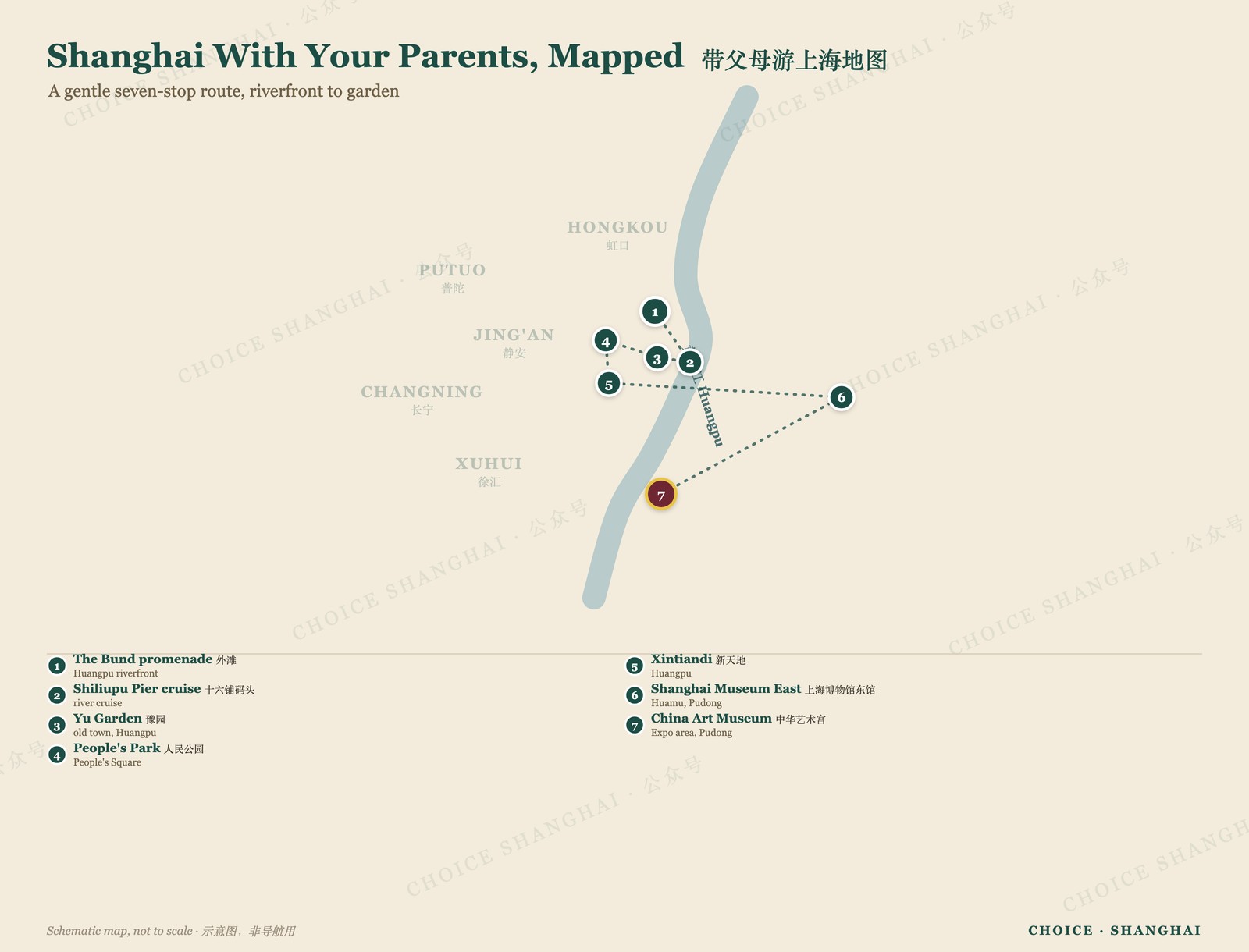
A comfortable day is one anchor sight plus a long, sit-down lunch. The easy ones: the Bund promenade (free, flat, wide, benches, the classic skyline), a Huangpu River cruise from Shiliupu Pier (a 50-minute loop, ¥90 to ¥135 by season, senior discount on site), and the free Shanghai Museum East in Pudong, fully step-free with benches and no reservation needed. The China Art Museum in the old Expo pavilion is another step-free big venue, and Xintiandi and People's Park are flat, shady strolls. See Yu Garden's bazaar and exterior, but skip the stone interior.
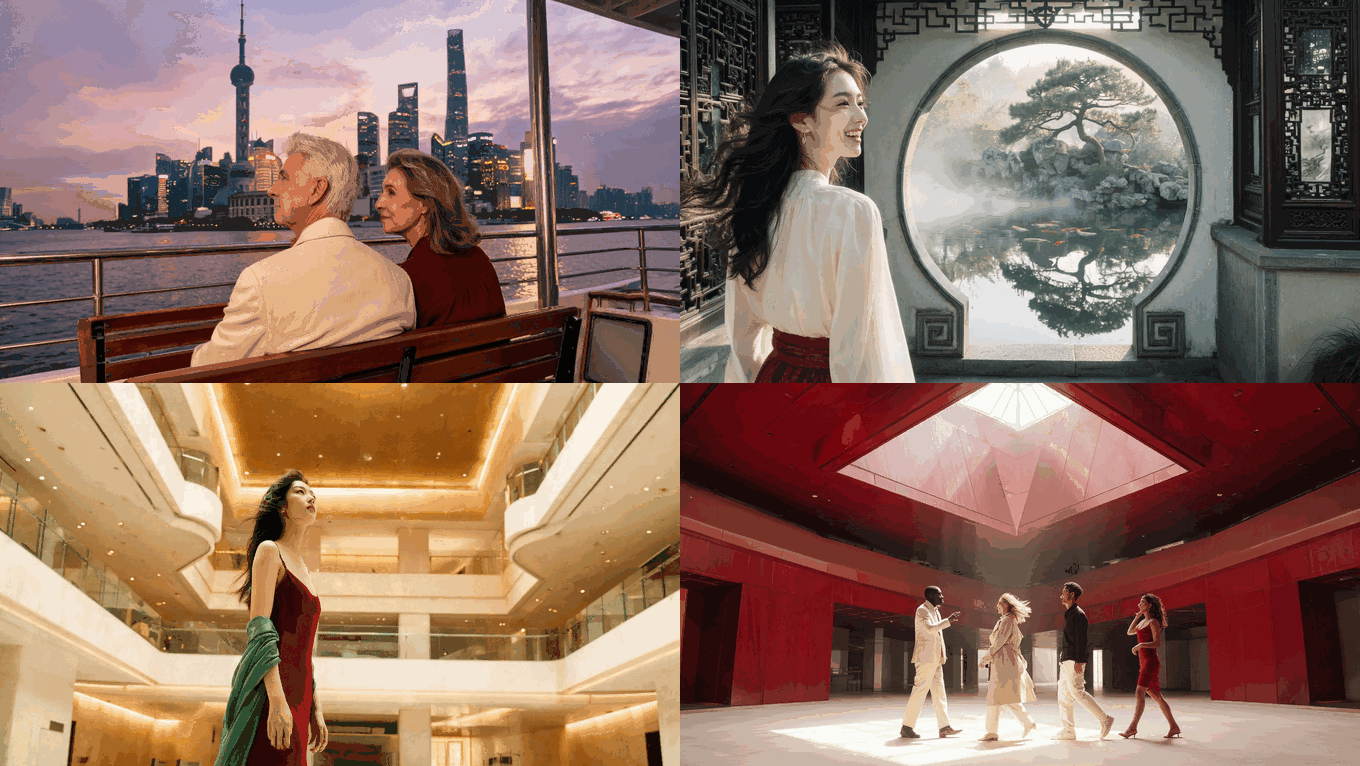
Day trips work by high-speed rail: Suzhou is 23 to 40 minutes from Hongqiao (¥31 to ¥46 second class), Hangzhou's West Lake about 45 to 60 minutes. Both are beautiful, but the classical gardens have steps and zigzag bridges, so treat them as a walk-what-you-can day, not a checklist. Our guides to Shanghai's museums and day trips from Shanghai go deeper.
Where to stay so everything is close
Base them centrally in Huangpu (the Bund, Nanjing Road, Xintiandi) or Jing'an (Nanjing Xi Lu), where the sights are walkable and the English service is reliable. As a rough 2026 guide, mid-range comfort runs about ¥700 to ¥1,200 a night (the Central Hotel Shanghai sits by the Nanjing Road mall), upper-range ¥1,300 to ¥2,200 (the Langham Xintiandi and the Portman Ritz-Carlton draw repeat praise for English-speaking staff), and the Fairmont Peace Hotel on the Bund runs ¥2,000 to ¥3,500 for the art-deco landmark. Rates swing hard by date and season, so treat these as bands and book early. More in our guide to where to stay in Shanghai.
Food they'll actually eat
The fear with older parents is spice and strangeness, and Shanghai handles both. Din Tai Fung (branches on Nanjing Xi Lu, in Xintiandi and at IFC Pudong, ¥150 to ¥250 a head) is the safe first dinner: picture-and-English menus, spotless rooms, gentle soup dumplings and greens. For a step up, Lei Garden and Imperial Treasure do quiet, mild Cantonese dim sum (¥200 to ¥500 a head). Hotel breakfasts are worth it, and every good hotel restaurant has an English menu. Save the numbing-hot Sichuan and the adventurous street food for your own nights.

Getting around without wearing them out
The simplest door-to-door option is a taxi or Didi. A metered taxi starts around ¥14 to ¥16 for the first three kilometres, then roughly ¥2.50 a km; Didi's private-car tier is similar and books through the app in English. The metro is spotless and, by 2026, every station has an elevator and step-free access, but often only one entrance has the lift, so for tired parents the taxi wins. For a big sightseeing day, a private car with an English-speaking driver runs from about ¥1,400 for eight hours.
Set up their phones before they land. Both Alipay and WeChat Pay now let a visitor link a foreign Visa or Mastercard with no Chinese bank account, and payments under ¥200 are free; if a parent is nervous about a card, Alipay's prepaid Tour Pass caps the risk. Add a China travel eSIM for data so Google and WhatsApp work, and keep their home SIM on roaming for verification codes. The safety net that changed in 2026: a national rule makes refusing cash illegal, so small notes always work. See our guides to Alipay and WeChat Pay and the airport into the city.

Health, medication and the just-in-case
Pack regular medication in its original labelled packaging with a doctor's letter or prescription in English; a Chinese translation helps at the border. Most everyday medicine is over the counter at any pharmacy (药房) with no prescription. For anything serious, dial 120 for an ambulance, but note that a 120 ambulance goes to the nearest public hospital, not an international one. For English-speaking care, ParkwayHealth (appointment line 400-819-6622, central clinic at Xintiandi) and Shanghai United Family Hospital are the expat standards. Buy senior travel-medical insurance before the trip: home plans and Medicare do not cover China, and a policy with real medical and evacuation cover runs around USD 400. Our medical emergencies guide covers the hospital side.

Which plan is for you 哪种适合你
If your parents carry a UK, Canadian, EU, Australian or similar passport, a round trip is visa-free for 30 days, so just book the flights. If they are American, get the L tourist visa now rather than gambling on the transit rules. If they are fit and curious, give them the Bund, the cruise, a museum and a water town. If they tire easily or use a wheelchair, stay central, lean on taxis and the step-free museums, and skip the old-garden interiors. Whatever the plan, book one main thing a day: the trip they remember is the long lunch and the river at dusk, not the fourth temple.
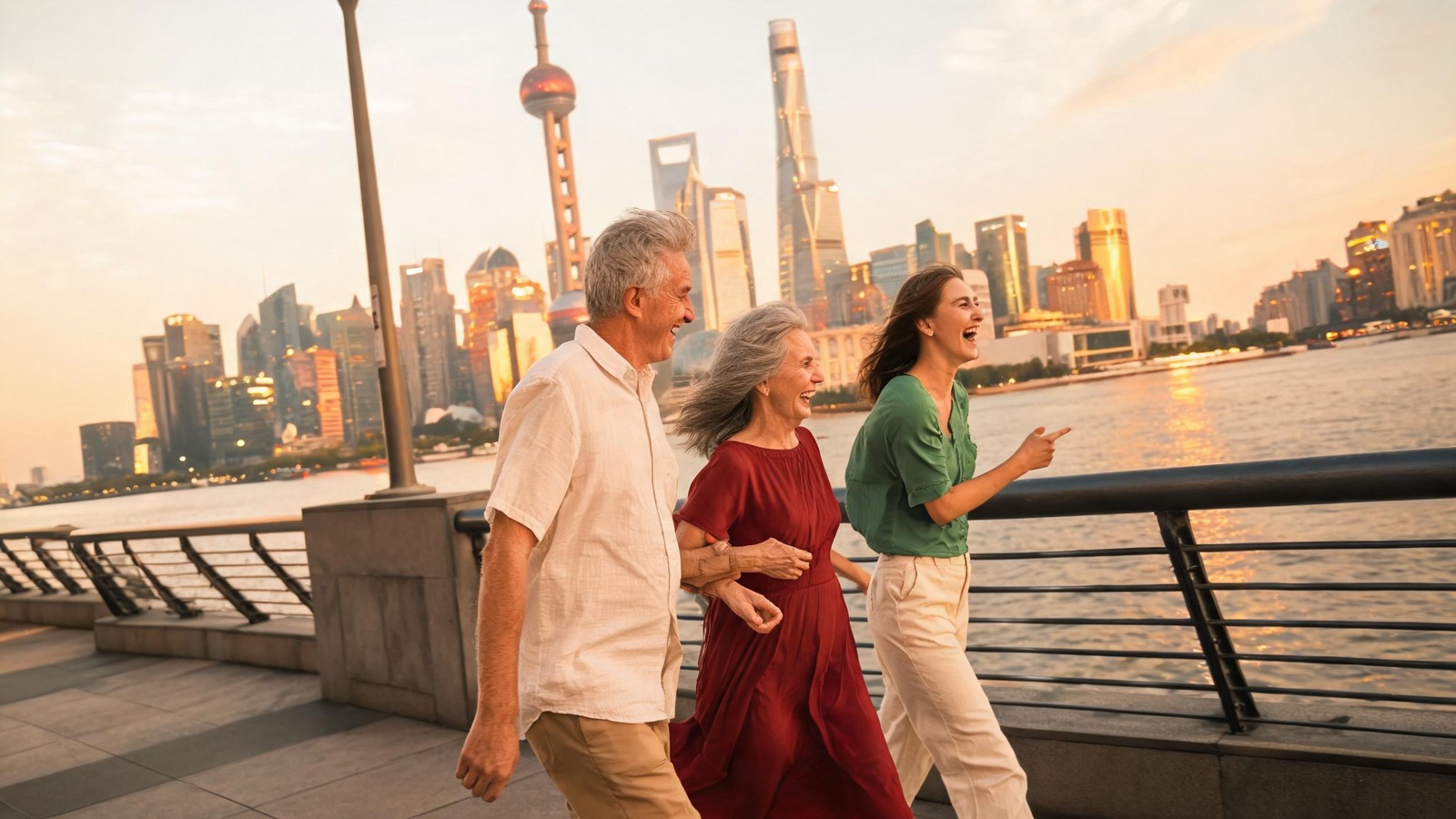
Confucius asked, 有朋自远方来,不亦乐乎, is it not a joy when friends come from far away. Parents are the first far friends most of us ever had, and showing them your Shanghai becomes its own quiet homecoming.
Do my parents need an invitation letter for a China tourist visa?
In almost all cases, no. Since January 2024, applicants in the US no longer submit an invitation letter, flights or hotel bookings, and other consulates usually accept a flight and hotel booking alone. If yours still asks, write the letter as their resident child, with a copy of your passport and residence permit.
Do my parents need a visa to visit Shanghai?
Usually no. As of 2026, passport holders from around 50 countries, including the UK, Canada, the EU, Australia, New Zealand, Japan and South Korea, enter visa-free for up to 30 days on a normal round trip. The exception is US holders, who need an L tourist visa or a 240-hour transit route onward to a third country.
What time of year is easiest for bringing elderly parents to Shanghai?
Spring (March to May) and autumn (late September to November) are the comfortable seasons. Avoid the humid 35°C summer, the damp cold of deep winter, and the October 1 to 7 national holiday when everything is packed.
Is Shanghai accessible for older or limited-mobility travellers?
The modern city is: museums, the Bund and the metro all have elevators and step-free access. The old gardens and water towns are stepped and uneven, so plan those as walk-what-you-can days and use taxis over the metro when they tire.
How will my parents pay for things without a Chinese bank account?
Alipay and WeChat Pay accept a foreign Visa or Mastercard directly, and since 2026 a national rule makes refusing cash illegal, so small notes always work as a backup. Set the apps up before they arrive and keep their home SIM on for verification codes.
What should I do about my parents' medication and health cover?
Bring medication in original packaging with an English prescription, buy senior travel-medical insurance (home plans and Medicare do not cover China), and save the numbers for ParkwayHealth or Shanghai United Family for English-speaking care. Dial 120 for an ambulance in an emergency.