
Citizens of 55 countries can visit Shanghai without a visa for up to 240 hours, provided the onward ticket goes to a third country and the passport has three months left.
As of August 2026, citizens of 55 countries can enter Shanghai without a visa for up to 240 hours (10 days) if they hold a passport valid at least three months, arrive at an approved port, and carry a confirmed onward ticket to a third country or region. Immigration issues a temporary entry permit at the transit counter, and the 240 hours start at 00:00 the day after you land, not the moment you land.
I’ve helped about forty friends pull this off. Most sailed through in minutes. One got stuck an hour with no printed onward ticket and a dead phone, and still made it, barely.
The transit is a genuinely easy way to visit China, but easy still comes with rules, and much of what is online dates from the old 72-hour and 144-hour versions. The National Immigration Administration (国家移民管理局) folded those into one 240-hour policy in December 2024. What follows is the 2026 version.
First, check whether you even need the transit route
Here is what most travel pages miss. Since 2024 China also runs a separate 30-day visa-free entry for ordinary passport holders, and as of February 2026 that list reached about 50 countries, including the UK, Canada, all of the EU, Australia, New Zealand, Japan and South Korea. Hold one of those passports and you can fly into Shanghai for up to 30 days on a normal round trip: no onward third country, no visa, no application. The National Immigration Administration confirmed the current list on 17 February 2026, and it runs through 31 December 2026.
That removes the one worry people bring to the transit rule. London to Shanghai and back is a round trip, which fails the 240-hour transit but is exactly what the 30-day entry is for. For most nationalities it is the easier route: a longer stay, no routing puzzle, you leave and return the way you came, and the requirements are lighter, an ordinary passport valid at least three months, an approved port such as Pudong or Hongqiao, and proof of onward or return travel and where you are staying.
You want the 240-hour transit in three cases: your passport is not on the 30-day list, the notable one being the United States, which still needs an L visa or the transit; you are genuinely passing through China to another country; or your trip is short and the routing lines up anyway. Either way you still register your address with the police within 24 hours. And if you want to stay past 30 days, or to work, study or repeat the trip often, get the proper visa rather than stretch either policy. The rest of this guide is the transit playbook.
The rules (the real ones, not the Reddit version)
The routing rule: you must be transiting through China, not ending there. Country A → China → Country B, and B must differ from A. Tokyo → Shanghai → Bangkok works. Seoul → Shanghai → Seoul is a round trip, and does not.
The loophole everyone asks about: Hong Kong, Macau and Taiwan all count as different destinations, so Hong Kong → Shanghai → Tokyo works, and so does Singapore → Shanghai → Hong Kong. That opens up a lot of routing, especially from Southeast Asia.
When the clock starts: the 240 hours count from 00:00 the day after you arrive, not on landing, so a Monday 2pm arrival runs to midnight the following Thursday, effectively 10 full days plus the rest of your arrival day. People read this pessimistically and book their departure a day early.
Passport and permit: at least three months remaining on an ordinary passport, with diplomatic and some special documents following different rules. What you get is not a visa but a temporary entry permit, issued at the transit counter; you need it to leave the airport and keep it until you fly out.
Where you can go: once limited to Shanghai, Jiangsu and Zhejiang, the policy now covers 24 provinces, regions and municipalities, including Beijing, Guangdong, Sichuan and most major tourist regions. See Shanghai, take a high-speed train to Hangzhou, pop over to Suzhou, and still have days left.
Where you can enter: the approved port list grew from 39 to more than 60 when the policy expanded, and keeps growing. Alongside Pudong (PVG) and Hongqiao (SHA), it includes the Nanjing, Hangzhou and Ningbo airports; Hong Kong West Kowloon Railway Station was added on 5 November 2025, which matters if you route through Hong Kong by train. Your entry and exit ports do not have to match.
My favorite routing hack from Southeast Asia: Bangkok → Shanghai (240 hours visa-free) → Hong Kong. No visa for either city, and the flight between them is under three hours. A friend did six days in Shanghai and three in Hong Kong in May, paperwork total: zero.

At the airport: what actually happens
You land and follow signs to immigration. At Pudong (PVG) there is a dedicated lane for transit visa-free passengers; at Hongqiao (SHA) it is less clearly marked, but the officers know the drill. They check your passport, your onward boarding pass or e-ticket, and that your routing qualifies (A → China → B, different countries), then stamp you in with a temporary entry permit.
Have that onward ticket printed; your phone battery is not as reliable as you think at 1am after a long flight. Immigration takes fifteen minutes on a quiet day, up to an hour on a packed arrival at peak time. You can also pre-register online before you fly, which flags a wrong nationality or a routing issue before you board rather than after you land.
The five mistakes that trip people up
1. Round-trip routing. Tokyo to Shanghai and back to Tokyo is not a transit, and this catches more people than any other rule.
2. No printed ticket. Digital is usually fine, but if your phone dies you are explaining yourself to an officer with sixty people behind you. Print the confirmation.
3. Overstaying. The 240 hours is strict. Overstaying by even a few hours brings fines, detention and a mark on your record that complicates future visits. Set an alarm for 24 hours before departure.
4. Forgetting mobile payment. China runs on Alipay and WeChat Pay; many shops, restaurants and taxis no longer carry change. Link your Visa or Mastercard to Alipay before you land. (We wrote a whole guide on this.)
5. Assuming Wi-Fi is everywhere. Get a local SIM or an eSIM before arrival. You need a working phone for payments, maps (Google Maps does not work here; use Amap or Baidu Maps) and ride-hailing (Didi). Airport SIM cards work fine, five minutes at the counter.
Do you have to register with the police?
Yes, within 24 hours of reaching your address, exactly as residents must. A hotel or serviced apartment files it when they scan your passport at check-in. In a friend’s place or a private rental, you register yourself at the local police station or online, with your passport and the address. It takes minutes and costs nothing. Our 24-hour registration guide covers both routes.
What if your onward flight is cancelled?
Go to the exit and entry administration of the local public security bureau before your 240 hours run out, not after. A cancelled flight, illness or genuine force majeure is a recognised reason for a short extension, and it is straightforward when you ask early with the airline paperwork in hand. Wait until the clock has expired and a simple errand becomes an overstay. Rebook first, then go, with your passport, your permit and proof of the cancellation.
Which route is for you 哪个适合你
Quick test: if your passport is on the 30-day list, fly a normal round trip; if not, and you have a genuine A to China to B routing, use the 240-hour transit and save the visa fee. Hong Kong, Macau or Taiwan each count as a separate destination.
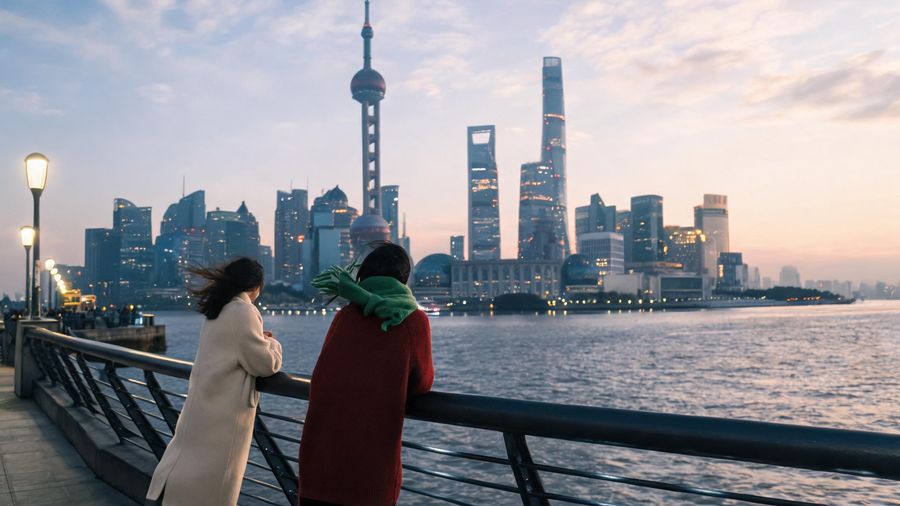
What to do with 240 hours
Ten days is generous; most visitors need five to fall for Shanghai. A loose framework, and for the detailed day-by-day version, see our 3-day itinerary and double it.
Days 1 to 3: Shanghai proper. Walk the Bund at golden hour. Get lost in the lanes around Julu Lu and Wulumuqi Lu. Eat dumplings that cost 12 RMB and taste like they should cost five times that. Hit a rooftop bar (we have opinions on which ones). Wander a night market.
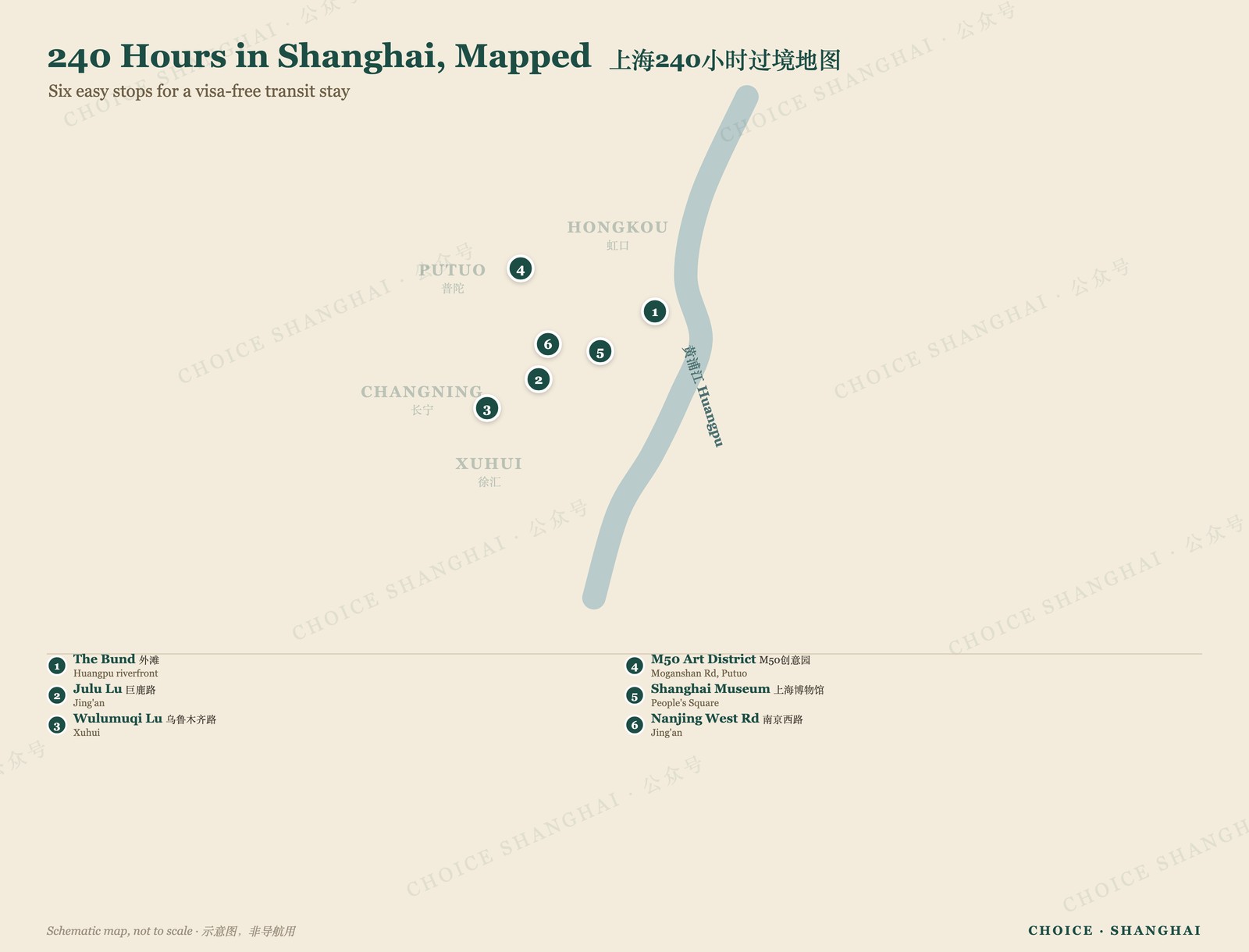
Days 4 to 5: deeper Shanghai. The M50 art district. A neighborhood coffee shop in Changning. The Shanghai Museum’s ancient Americas exhibition, running through late 2027 and worth the trip alone, with night events July through August.
Days 6 to 8: day trips. Suzhou is 25 minutes by high-speed train, Hangzhou about an hour, both gorgeous and both easy. Moganshan, a mountain retreat with bamboo forests and boutique hotels, is a two-hour drive and my favorite summer escape from the city.
Days 9 to 10: wind down. Last-minute shopping on Nanjing Lu (skip the tourist stretch, head to Jing’an). A final bowl of the noodles you will be thinking about on the flight home. Get to the airport early. Leave with stories.
Frequently asked
Can I visit Shanghai without a visa in 2026?
Yes, and simpler than before for most nationalities. Ordinary passport holders from about 50 countries, including the UK, Canada, the EU, Australia, New Zealand, Japan and South Korea, get up to 30 days on a normal round trip, through 31 December 2026. If your passport is not on that list, the United States being the common case, use the 240-hour (10-day) transit: an onward ticket to a third country or region, and entry through an approved port like Pudong or Hongqiao.
Can I fly round trip to Shanghai without a visa?
If your passport is on the 30-day list, yes: a normal round trip, for example London to Shanghai and back, for up to 30 days. A round trip only fails under the separate 240-hour transit, which requires an onward flight to a third country or region.
Which countries qualify for China’s 240-hour visa-free transit?
55 countries, including the US, UK, Canada, Australia, most EU nations, Japan and South Korea. Check the latest official list before booking, as it is occasionally updated.
When does the 240-hour clock actually start?
At 00:00 the day after you arrive, not the moment you land. Arriving Monday afternoon, the count begins midnight Tuesday, so you effectively get your arrival day plus ten full days.
Do I need a return ticket for China visa-free transit?
No, an onward ticket to a third country or region, confirmed with a date and seat, departing within 240 hours. A ticket back to where you flew in from is a round trip and does not qualify.
Do I need to register with the police on visa-free transit?
Yes, within 24 hours of reaching your address. A hotel files it for you at check-in; if you stay in a private home you register at the local police station or online yourself.
What happens if I overstay the 240 hours?
Overstaying is treated as an immigration violation and can bring fines and a record that complicates later trips. If your departure is disrupted, go to the exit and entry administration of the public security bureau before the deadline, not after.
Can I leave Shanghai during the 240-hour visa-free transit?
Yes. The policy now covers 24 provinces, regions and municipalities across mainland China, so you can travel to Hangzhou, Suzhou, Nanjing, Beijing and many more.
Sources · 资料来源
- National Immigration Administration · 国家移民管理局, announcement "China's Visa Free Transit Policy Fully Relaxed and Optimized" (2024), which set the 240 hour (10 day) stay and the eligible ports including Shanghai, nia.gov.cn
- National Immigration Administration (English portal) · 国家移民管理局, Visa Free Transit Policies (2025), covering eligible countries, permitted areas and how the stay is counted, en.nia.gov.cn
- The State Council of the People's Republic of China · 中华人民共和国国务院, news release "China's visa free transit policy fully relaxed and optimized" (2024), gov.cn
- Shanghai Municipal Foreign Affairs Office · 上海市人民政府外事办公室, consular reminder on the expansion of the 240 hour transit list to 55 countries (2025), wsb.sh.gov.cn
- This is general guidance drawn from official sources, not legal or immigration advice. Eligible countries, ports and stay rules change; confirm the current requirements with the National Immigration Administration or your carrier before you travel. 请在出行前向国家移民管理局核实最新规定。
As Sun Tzu wrote, 知己知彼,百战不殆, know yourself and know the other, and you are never in danger. A border rewards the traveller who reads the rules before the rules read them, and a clock understood is a clock that works in your favour.