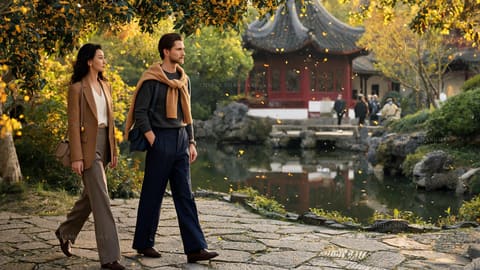
Autumn, roughly late September to late November, is the season Shanghai earns back your love: the summer humidity lifts, the sky goes clear blue.
If you only love Shanghai for one season, make it autumn. From late September the summer humidity finally lifts, the sky turns a blue it never manages in July, and the days settle into warm afternoons and cool evenings with barely any rain. The plane trees go gold, the osmanthus scents whole streets, and the city that hid indoors all August pours back outside. The one catch is the National Day holiday in early October. Time around that, and these are the standout weeks of the year.
Good to know
- go-to for: anyone who survived the summer, and visitors deciding when to come. October is the answer.
- What it costs: nothing but a light layer for the evenings. Only hotels and flights spike, and only during National Day week, so book around it.
- Don't miss: the osmanthus in October and the plane trees turning gold in November. Keep travel out of the month's first week.
When does autumn actually arrive in Shanghai?
Later than the calendar says. Early September is still summer here, hot and sticky, with the odd late typhoon. The real turn lands in the last week of September, when the humidity drops and you can walk a block without changing your shirt. October is the sweet spot, dry and bright. By November it is properly crisp and you will want a coat after dark.
So October is for planning the outdoor things, and November is for the gold plane trees, just as it turns cold enough for a jacket. Both are a relief after the summer survival months, and both sit safely past the worst of typhoon season, which winds down by early October.
The two things that make a Shanghai autumn

First, the smell. In October the city's osmanthus trees (桂花, guìhuā) bloom all at once, and for two or three weeks a warm apricot-honey scent drifts out of parks and off street corners when you least expect it. You smell it before you spot the tiny gold flowers, and it turns up in seasonal drinks and mooncakes around the Mid-Autumn Festival.
Second, the plane trees. The tunnels of London plane (法国梧桐) arching over the lanes of Xuhui and Jing'an turn amber and gold in mid-to-late November, and for a fortnight the old shikumen streets look like a film set. Wukang Lu, Anfu Lu and the quiet blocks around them are the classic walk. Go on a weekday morning: softest light, thinnest crowds.
Where the leaves actually peak, and when
"When do the leaves turn" is the autumn question we get most, and the honest answer is later than people expect. Different trees peak in different weeks, so here is the cheat sheet before you plan a special trip.

The free classic is walking Wukang Lu 武康路 and Anfu Lu 安福路 in Xuhui when the plane trees turn gold overhead. For proper colour, three parks carry it: the Shanghai Botanical Garden 上海植物园 (free main gate, osmanthus from late September then ginkgo through November), Gongqing Forest Park 共青森林公园 in Yangpu (free, with the widest range: maple, ginkgo and lakeside dawn-redwood), and Century Park 世纪公园 in Pudong (free, easy to reach on Line 2). One big wind strips the plane trees in a day, so check the forecast before a special trip.
What to do in the good weeks
This is the season to be outside, so front-load the outdoor plans. Walk the riverside, the West Bund and the Bund are made for a clear autumn morning. Catch a rooftop while it is still warm, because the rooftop bars shut their terraces once November bites. Take a slow, planless park day in Fuxing Park or Century Park with a coffee.
Then there is the food. Hairy crab comes into season, and if you have never sat down to a steamer of them with warm rice wine, this is the year, our guide to hairy crab season covers where to go and how not to overpay. The mild weather is also the last easy window for a trip out of town before the cold, and the nearby weekend getaways like Hangzhou and the water towns are at their prettiest with the leaves turning.
The autumn walk to actually do: the Suzhou River

If autumn is for being outside, give an afternoon to the Suzhou River (苏州河), Shanghai's own quiet answer to a riverside promenade. One flat, breezy path strings together heritage bridges, a century-old red-brick campus and a few genuinely strange buildings, half old-money romance and half everyday city. It runs about 9 km end to end, lovely on foot or by shared bike.
The stretch locals photograph all day runs west to east. Start at Zhongshan Park (中山公园) and drop down to East China University of Political Science and Law (华东政法大学), whose 1900s red-brick campus, the old St John's, opens onto the water along the riverside walkway (苏河华政步道). From there you pass Mengqing Park (梦清园), green with water on three sides; Tian'an 1000 Trees (天安千树), a terraced hillside of a building with a tree on every column; and M50 (M50创意园), an old textile mill turned gallery quarter. Detour for the Mondrian-coloured Chuangxiang Tower (创享塔) and the butterfly-shaped Butterfly Bay Garden (蝴蝶湾花园) if your legs are willing.


Save the bridges for last. Zhejiang Road Bridge (浙江路桥) is a rare 1908 fish-belly steel truss, and the walk finishes at the Waibaidu Bridge (外白渡桥), the romantic 1908 span where the Suzhou River meets the Huangpu beside the Bund. Walk it in about three hours, or bike it in one; if you tire, the metro and a Didi are never far. Go on a weekday afternoon and the golden light is almost yours alone.
The one thing to plan around: National Day
Early October brings the National Day holiday, the second Golden Week, and it reshapes the whole month. Hundreds of millions travel in the same few days, so trains and flights sell out and jump in price, sights fill up, and popular restaurants run an hour's wait. It is not a reason to hide, Shanghai can be oddly lovely when the locals leave, but it is a reason to choose: book intercity travel well ahead, or stay put and enjoy the quiet city. Our honest read on whether to stay home or escape for Golden Week lays out both plays.
What to wear right now
Right now, in the high-twenties, it is still short sleeves and a light layer for the evening, no jacket needed yet. Through October, days stay t-shirt-warm and only the evenings cool off. By November, add a proper coat and a scarf for the mornings. Homes have no central heating until deep winter, so autumn is the last comfortable stretch before the indoor chill arrives too. If you remember one thing: October is the month to be outside in Shanghai, so plan the good stuff before you talk yourself out of it.
As Laozi wrote, 祸兮福之所倚,福兮祸之所伏, misfortune is what fortune leans on, and fortune is where misfortune hides. Autumn feels this tender because winter is folded quietly inside it, and the good weeks read richer for knowing they pass.
Which month is go-to for visiting Shanghai in autumn?
October, without much argument: dry, clear, warm at around 22 to 25C, with the osmanthus in bloom. Just skip the National Day week at the very start of the month, when the whole country travels and prices and crowds spike. Aim for mid-to-late October.
When do the leaves change colour in Shanghai?
It depends on the tree. The London plane trees along Xuhui and Jing'an turn gold in mid-to-late November, peaking into early December; ginkgo peaks a little earlier and the lakeside dawn-redwood a little later, into mid-December. See the timing table above for which park to pick for each.
Is Shanghai still humid in autumn?
Much less. The muggy heat breaks in the last week of September, and from October the air turns noticeably drier and cooler. Early September can still be hot and sticky, so for the crisp version of autumn, come from October onward.
What is osmanthus and why does everyone talk about it?
Osmanthus (桂花) is a small tree whose tiny gold flowers bloom across the city for a few weeks in October, filling the streets with a sweet apricot-honey scent. It flavours seasonal drinks, cakes and mooncakes, so you taste it as well as smell it.
Do you need a coat in Shanghai in autumn?
Not in October, when a light layer for the evening is plenty. By November you will want a proper coat and a scarf, especially in the mornings, as lows drop toward 10C. With no central heating in most homes, warm layers earn their keep indoors too.
Words, maps and research by the Choice Shanghai team. Please credit us and tag our 公众号 if you share.