Worth Doing · Travel
Weekend Getaways from Shanghai 2026: Where to Go When the City Gets Too Hot
Shanghai in July is a city that loves you and tests you at the same time. Thirty-eight degrees, 80 percent humidity, and the air feels like someone left a hot towel on your face. Here are the escapes that actually work, ranked by how fast they can lower your body temperature and your stress level.
Every summer, around the third consecutive day of 37-degree heat, the same question appears in every expat WeChat group: “Where can I go this weekend that isn’t this?”
After eight summers, I’ve tried most of the options. Some are worth it. Some are just trading Shanghai’s heat for a different city’s heat plus a train ride. Here’s what I actually recommend when people ask.
Two and a half hours by car from central Shanghai. About 700 meters up a mountain covered in bamboo. And the moment you step out of the car, you feel it: the temperature drops 5-8 degrees, the air smells like wet earth and green things, and your shoulders come down from your ears for what feels like the first time in weeks.
Moganshan (莫干山) has been Shanghai’s escape valve since the 1800s, when foreign diplomats and missionaries built summer villas in the bamboo forest to survive the Yangtze Delta heat. The old stone villas are still there, and some have been converted into boutique hotels that range from rustic charm to genuinely luxurious.
What to do: Walk. Seriously, that’s it. Walk through bamboo groves. Sit on a terrace and read a book you’ve been meaning to read for six months. Eat farm-to-table food that tastes the way food is supposed to taste. The village has a few decent restaurants, and most hotels serve meals. Don’t plan too hard. The point is to not plan.
The honest bit: Weekend traffic can be rough. Friday evening departures from Shanghai mean 3.5-4 hours instead of 2.5. Leave early Saturday morning, or better yet, take a Thursday night if you can swing it. Also: Moganshan is cooler, not cool. It’s still summer. Bring a light layer for evenings, but don’t expect sweater weather.
Budget: Boutique hotels run 600-3,000 RMB per night. A solid midrange stay (clean, nice view, decent breakfast) is around 800-1,200 RMB. Book a few weeks ahead in summer. Weekends fill up.

I go to Moganshan at least twice every summer. My move: leave Shanghai at 6am Saturday, arrive by 8:30, spend two nights, drive back Monday morning before the traffic. Total cost for two: around 2,500 RMB including a nice hotel, meals, and gas. That’s cheaper than a lot of Shanghai weekend brunches, and infinitely better for your mental health.
Fifty minutes by high-speed train from Hongqiao. Trains every 10-15 minutes. About 75 RMB for second class. You could wake up in Shanghai, have lunch by West Lake, and still feel like you traveled somewhere meaningful.
West Lake is as beautiful as everyone says. The trick is timing: early morning (before 8am) or late afternoon (after 5pm) when the light is soft and the selfie-stick density drops to manageable levels. Walk the Su Causeway at 7am on a weekday and you’ll have it nearly to yourself. Do it at 2pm on a Saturday and you’ll understand why people complain about crowds.
Beyond the lake: Longjing Village, about 20 minutes from West Lake by taxi, is where the famous Dragon Well tea comes from. You can sit in a tea farmer’s garden, drink tea that was picked that week, and eat simple local food while looking at rows of tea bushes climbing the hillside. It’s the most peaceful afternoon I’ve spent outside Shanghai.
Food worth the trip: Hangzhou cuisine is sweeter and more delicate than Shanghai’s. Dongpo pork (东坡肉), braised until it melts, is the signature. Beggar’s chicken (叫化鸡), wrapped in lotus leaves and clay-baked, is the experience. Grandma’s Home (外婆家) has solid versions of both, and there are locations you won’t need to queue for two hours if you go early.
The honest bit: Hangzhou is not much cooler than Shanghai in summer. You’re trading city heat for lakeside heat. The appeal is the scenery and the pace, not the temperature. If you need actual relief from the heat, Moganshan is a better bet.
Twenty-five minutes. That’s the high-speed train from Hongqiao to Suzhou. It’s so fast that by the time you settle into your seat and open your phone, you’re arriving.
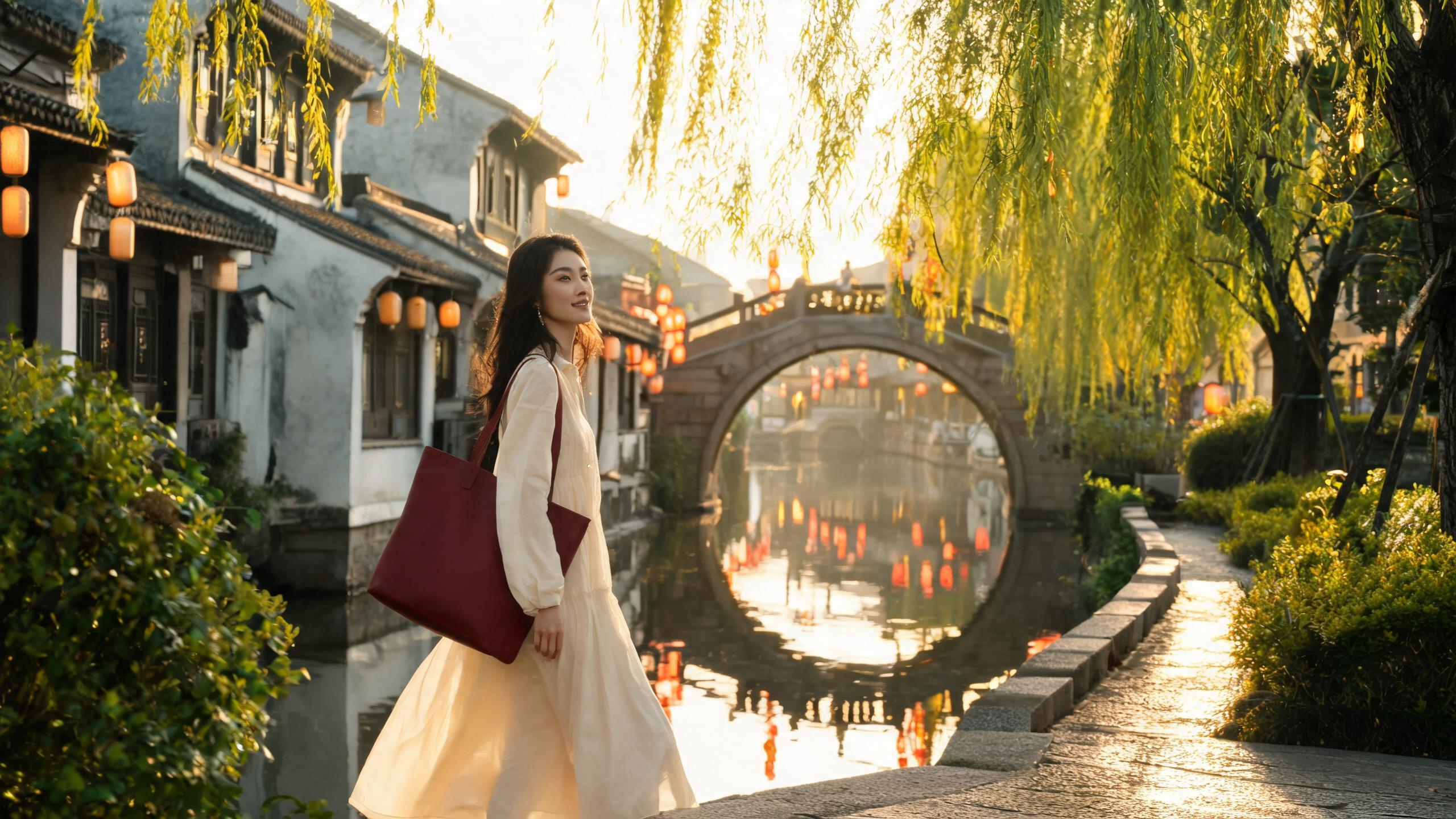
Suzhou is what people imagine when they think “classical China.” Canal-side streets, stone bridges, gardens designed to make you slow down and notice things. The Humble Administrator’s Garden (拙政园) and Lingering Garden (留园) are UNESCO-listed for good reason: they’re centuries-old exercises in making small spaces feel infinite.
The local move: Skip the famous gardens on weekends (packed) and head to Pingjiang Road (平江路), the old canal street. It’s touristy but genuinely pretty, and the side alleys are where you find the quiet: a tea house with three tables, a noodle shop that’s been open for decades, an old man playing erhu by the water.
For the adventurous: Tongli (同里) and Zhouzhuang (周庄) are ancient water towns about an hour from Suzhou proper. They get crowded on weekends, but on a Tuesday morning, walking through a 900-year-old town while a grandmother hangs laundry across a canal is the kind of scene that reminds you why you live in this part of the world.
If Moganshan feels too popular (and on peak summer weekends, it does), Anji (安吉) is the answer. About three hours from Shanghai by car, in the same general direction, but less developed and noticeably less crowded.
This is where they filmed parts of Crouching Tiger, Hidden Dragon. The bamboo forests are that kind of dramatic. Anji is also one of China’s major white tea regions, so you can pair mountain air with tea-tasting in a way that feels almost aggressively relaxing.
Stay: A handful of boutique mountain hotels have opened in the past two years, many with infinity pools looking out over bamboo valleys. Prices are generally 20-30 percent less than comparable Moganshan options. The tradeoff: fewer restaurant choices, so look for hotels with good in-house dining.
Shanghai doesn’t have beaches. Not real ones. The nearest actual ocean that you’d want to swim in is Zhoushan (舟山), an archipelago about four hours south by car and ferry, or three hours if you drive across the new bridge to the main island.
Putuoshan (普陀山), one of China’s four sacred Buddhist mountains, sits on a small island in the chain. Whether you’re interested in the spiritual side or just want a quiet island with clean air and seafood that was swimming that morning, it delivers.
The seafood: Zhoushan seafood is Shanghai restaurant seafood’s cooler older sibling. Grilled squid from a beach stall. Steamed yellow croaker so fresh it practically introduces itself. Clams in rice wine that cost 30 RMB and would cost 150 in a Shanghai restaurant with the same view.
The honest bit: Four hours is a commitment. This is a long-weekend trip, not a casual Saturday escape. And the beaches are not Bali. They’re nice, they’re clean enough, and the water is swimmable, but manage your tropical expectations. You’re here for the air, the seafood, and the quiet.
My ranking, if I’m being honest: Moganshan for a regular summer weekend. Suzhou when I have just one day and need a scene change. Hangzhou when friends visit and I want to show them something postcard-worthy. Anji when I want to disappear. Zhoushan when I need the sound of waves and have three days. Each one fixes a different kind of tired.
Moganshan is about 2.5 hours by car from central Shanghai. It sits at 700 meters elevation in a bamboo forest, and temperatures are typically 5-8 degrees cooler than the city. Boutique hotels range from 600 to 3,000 RMB per night.
High-speed trains run from Shanghai Hongqiao station to Hangzhou East station in about 50-60 minutes, departing every 10-15 minutes. Tickets cost around 75 RMB for second class. Book on Trip.com or the 12306 app. Book ahead for Friday afternoon and weekend departures.
Absolutely. Suzhou is just 25 minutes by high-speed train from Shanghai Hongqiao station. You can leave at 9am, spend a full day exploring the classical gardens and canal-side streets, and be back in Shanghai for dinner.
Run a hotel, resort, or travel experience near Shanghai? Let’s get you in front of the weekend-getaway crowd.
Work with Choice Shanghai