
A citywalk is a walk with intent, and Shanghai does it beautifully: flat, plane-tree shaded, laced with lanes.
A citywalk is just a walk with intent: a route you follow for the streets themselves, not to get anywhere. Shanghai does it better than almost any city because the good bits are flat, shaded by plane trees, and stitched together by lanes you would never drive down. Here are five routes worth the afternoon, each two to four kilometres, each ending somewhere you will want to sit down. Autumn, right now through November, is the season to do them.
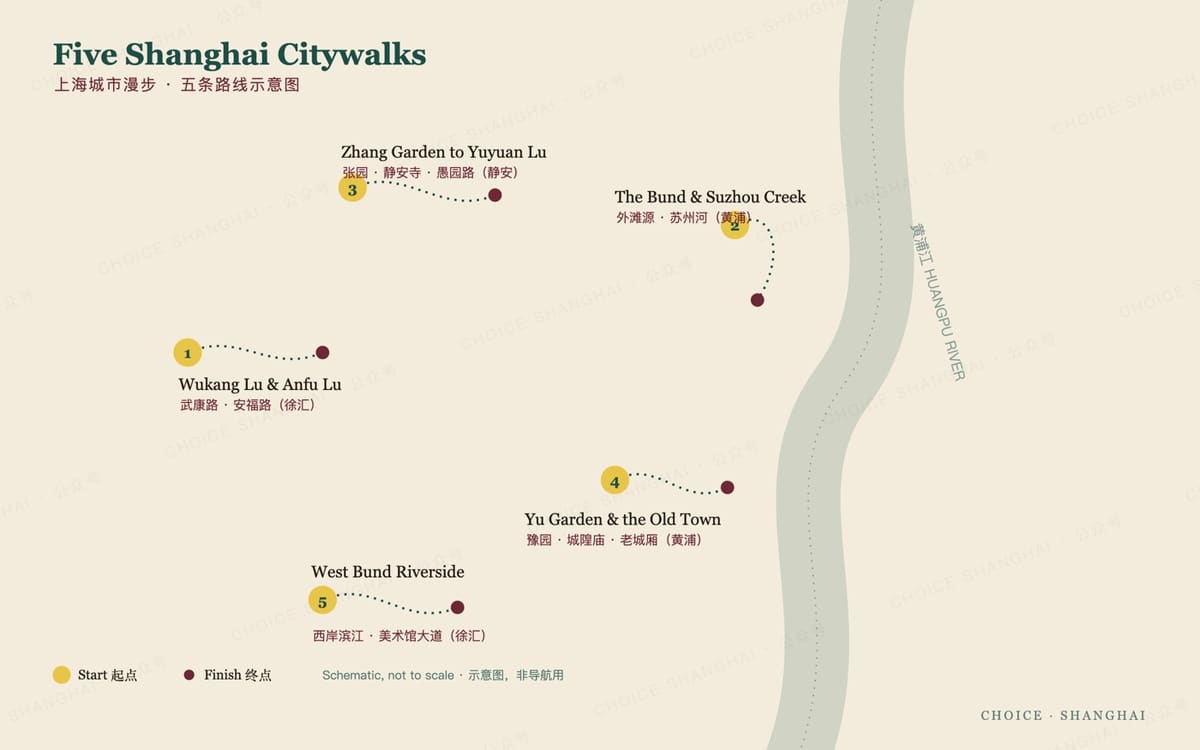
The trend has a name here, 城市漫步, and it has been quietly huge for three years running. You do not need a tour or a ticket for most of this, only comfortable shoes and a couple of free hours. We have mapped the five so you can see how they sit across the city; pick the one nearest a lunch you fancy. If you want the neighbourhood backstory first, our guide to living around Wukang Lu and our Jing'an local's guide go deeper on two of them.
Wukang Lu and Anfu Lu, the classic
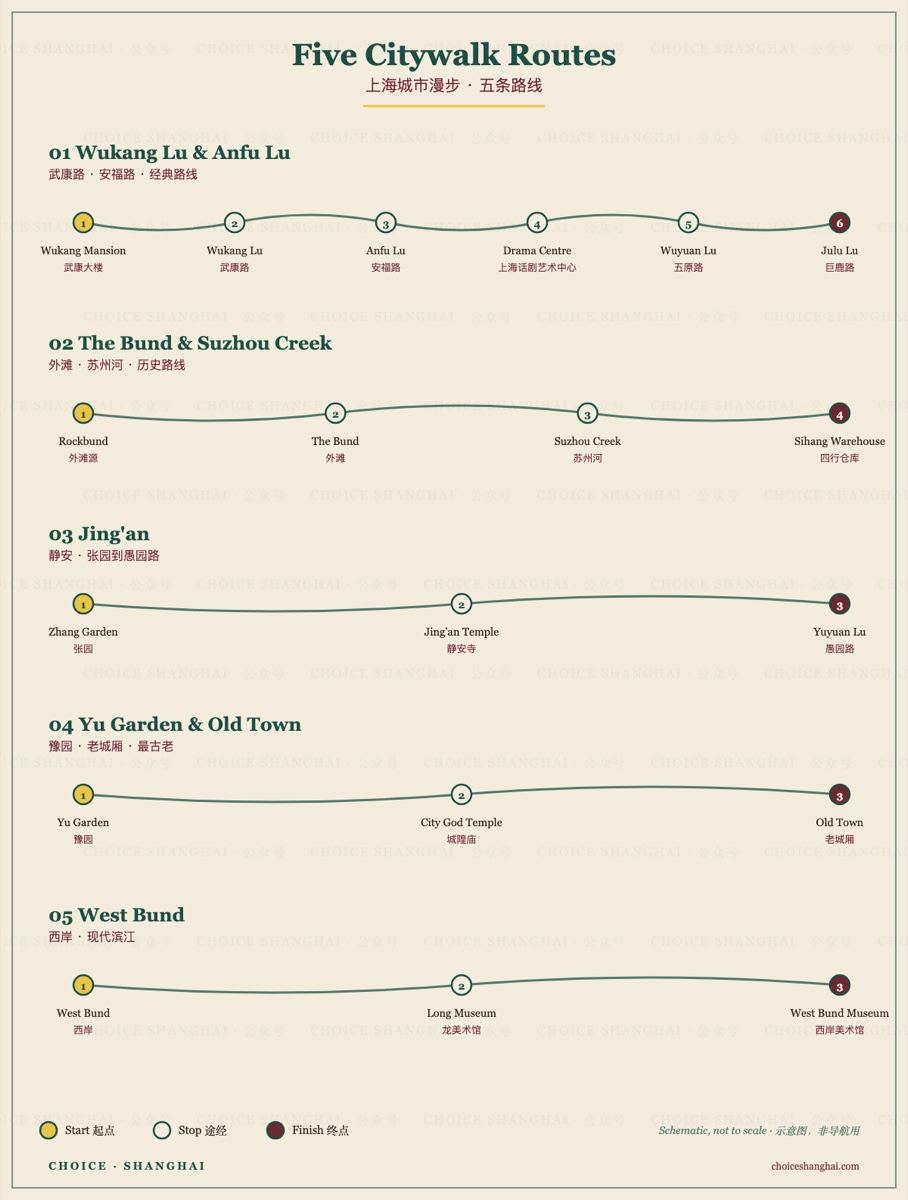
Start at the Wukang Mansion 武康大楼, the wedge-shaped 1924 landmark that everyone photographs from the opposite corner. Walk south down Wukang Lu 武康路 under the plane trees, past old villas and the odd wine bar, then cut onto Anfu Lu 安福路 for the independent shops, the Shanghai Dramatic Arts Centre 上海话剧艺术中心 and more cafes than one afternoon can hold. Finish along Wuyuan Lu 五原路 and Julu Lu 巨鹿路. It is the most-walked route in the city for good reason, so go on a weekday morning if you want the corner to yourself.
The Bund and Suzhou Creek, the history one
Begin at Rockbund 外滩源, the restored block of 1900s buildings just behind the waterfront, then join the Bund 外滩 promenade for the river and the skyline across it. Turn inland and follow Suzhou Creek 苏州河 upstream, a quieter, more local walk past converted warehouses, to the Sihang Warehouse Battle Memorial 四行仓库, a 1937 battle site that is now a museum. This one wants golden hour, when the light hits the far bank across the water.

Jing'an, from Zhang Garden to Yuyuan Lu
Start at Zhang Garden 张园, a restored block of shikumen lane houses now full of boutiques, walk past Jing'an Temple 静安寺 with its gold roof, then head west along Yuyuan Lu 愚园路, a long, low street of lane cafes, small galleries and everyday Shanghai life. One warning worth its own line: Yuyuan Lu the street (愚园路) is not Yu Garden the attraction (豫园), which is route four and the other side of town. This walk is the city's split personality, luxury and lane life, in a single hour.
Yu Garden and the Old Town, the oldest one
Begin at Yu Garden 豫园, the Ming-dynasty classical garden, then thread through the Shanghai City God Temple 城隍庙 bazaar, busy and touristy at its core. The reward is walking two streets out into the Old Town 老城厢, the last low-rise pocket of pre-boom Shanghai, where laundry hangs over lanes and nobody is selling you anything. Go on a weekday morning and skip the weekend crush.
West Bund, the modern riverside
The West Bund 西岸 is Shanghai's art mile: start near the Long Museum 龙美术馆 and the West Bund Museum 西岸美术馆, then walk the wide riverside path south past the running track, the galleries and the open sky. It is flat, uncrowded and long, the one route that doubles as a proper workout, which is why the city's run clubs use it too. Cap it with a coffee at one of the museum cafes.
How to actually walk them
Wear real shoes; Shanghai pavements are charming and uneven. Start earlier than you think, both to beat the heat that lingers into early autumn and to have the photogenic corners to yourself. Most routes sit near a Metro line, so you can bail at any point. And treat the map as a spine, not a rule: the minutes you remember from any citywalk are the lane you turned down because it looked interesting. For the wider seasonal picture, our Shanghai autumn guide has the good weeks pinned down, and the museums guide covers what to book if you want an indoor finish.
As Laozi wrote, 千里之行,始于足下, a journey of a thousand miles begins beneath your feet. The city you think you know changes entirely the moment you cross it on foot.
Good to know
- Good for: a free half-day, visiting friends, or falling back in love with the city on foot.
- What you'll pay: nothing for the walking; a garden or museum ticket is ¥30 to ¥50 (about USD 4 to 7) if you go in.
- Make the most of it: go on a weekday, start before the crowds, and let yourself detour off the route.
Common questions
What is a citywalk and why is it popular in Shanghai?
A citywalk is an unhurried route walked for the streets themselves rather than to reach a destination, known in Chinese as 城市漫步. Shanghai suits it because the central districts are flat, shaded by plane trees and laced with lanes, so a two-kilometre walk passes more character than a whole day in a car.
When is the ideal time of year for a Shanghai citywalk?
Autumn, roughly mid-September through November, is the comfortable season: mild, dry and with the plane trees turning gold. Spring is the runner-up. Summer is walkable only early morning or evening because of the heat and humidity, and winter walks work on the clear, cold days.
Do you need to pay or book anything for a citywalk in Shanghai?
No. The walking itself is free and needs no booking. You only pay if you go inside an attraction on the route, such as Yu Garden or a West Bund museum, where tickets run about ¥30 to ¥50 (about USD 4 to 7). Everything else is just streets, lanes and cafes.
Words, maps and research by the Choice Shanghai team. Please credit us and tag our 公众号 if you share.