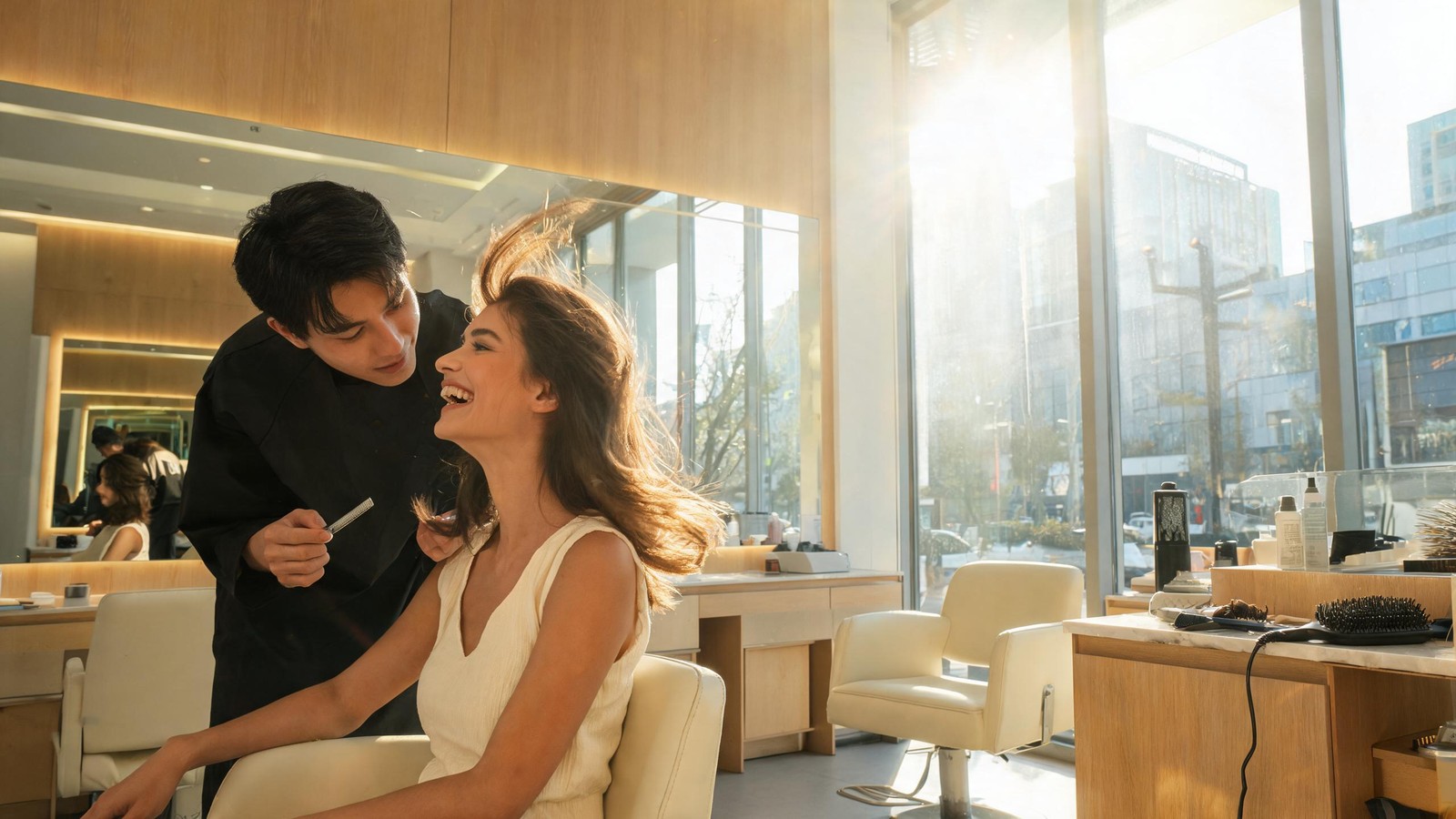
Looking for the Martin and Jin Shanghai price list? A wash, cut and blowdry at this English-speaking salon ranges from 180 to 380 RMB, depending on the stylist's rank.
A wash, cut and blowdry in Shanghai costs 50 to 120 RMB (about USD 8 to 18) at a neighbourhood salon, 180 to 380 RMB (USD 27 to 57) at a mid-range place with English-speaking stylists, and 400 to 800 RMB (USD 60 to 119) at an international chain. The price is set by the stylist’s rank, not the haircut. Bring reference photos and learn one phrase for declining the upsell.
I walked into a salon near Changping Lu, pointed at my head, said "just a little bit", and walked out forty-five minutes later with a layered K-drama protagonist look I had not asked for. The stylist was thrilled. I was speechless. The bill was 68 RMB.
Every expat in Shanghai has a haircut story. Most of them involve surprise bangs, an unexpected perm consultation, or leaving with a membership card they did not mean to buy. Getting a haircut here is not hard, but it is an experience with its own rules, and those rules are nowhere in English until you learn them the expensive way.
Here is everything I have figured out after eight years and more salons than I should admit to.
How the pricing tiers work (and why you might be paying for the wrong stylist)
Chinese hair salons have a ranking system called zhiji (职级). When you walk in, you are not just choosing a haircut, you are choosing a stylist tier. The price of the exact same haircut can range from 60 RMB to 600 RMB (roughly USD 9 to 89) depending on who holds the scissors.
At a typical neighborhood salon, the receptionist will ask which level stylist you want. If you do not specify, you will usually get a mid-range stylist. That is fine for a simple trim. But if you have curly hair, thick Western-textured hair, or something specific in mind, asking for a senior or director-level stylist is worth the extra 100 RMB. They have seen more hair types and are less likely to default to the one layered style they know.
The standard package: wash, cut, blow (洗剪吹)
In China, a haircut is a package deal called xǐ jiǎn chuī (洗剪吹): wash, cut, blowdry. You do not walk in, get a dry cut, and leave. You get the full experience: a shampoo at the back basin (often with a surprisingly good scalp massage), the cut, and a styled blowdry. The whole thing takes 30 to 50 minutes.
Some salons also throw in ear cleaning and a neck massage at the end, which is unexpected the first time and oddly pleasant every time after. Just go with it.
The upsell: how to say no (and mean it)
This is the part nobody prepares you for. Between the wash and the cut, between the cut and the blowdry, or sometimes mid-cut while you are captive in the chair, the upsell will begin.
“Your hair is very dry, would you like a treatment?” (+200-500 RMB). “We have a membership card, you save 30% on every visit.” (1,000-5,000 RMB upfront). “This keratin treatment will change your life.” (It will change your wallet.)
None of this is rude. It is the business model. Salons in China make a significant portion of revenue from membership cards and add-on treatments. The stylists are doing their job. But you need to know how to decline politely and firmly:
- 不用了谢谢 (bù yòng le xièxie): “No need, thanks”, your all-purpose shield
Say it with a smile, say it three times if needed, and they will move on. Do not feel bad. Everyone says no. The stylists are not offended. It is a ritual, not a negotiation.
The Chinese phrases that save your hair
You do not need to speak Mandarin to get a good haircut. But these six phrases cover 90% of what you need to communicate. Save them on your phone or screenshot this section:
- 剪短一点 (jiǎn duǎn yì diǎn): “Cut it a bit shorter”
- 不要太短 (bù yào tài duǎn): “Not too short”, arguably the most critical phrase
- 我想做这个发型 (wǒ xiǎng zuò zhè ge fà xíng): “I want this style”, show a photo when you say this
- 只剪头发,不染不烫 (zhǐ jiǎn tóufa, bù rǎn bù tàng): “Just a cut, no color, no perm”
- 两边推短,上面留长 (liǎng biān tuī duǎn, shàng mian liú cháng): “Short on the sides, keep it long on top”
- 可以了,很好 (kě yǐ le, hěn hǎo): “That’s good, I’m happy”, say this before they keep going
And the single most powerful tool: a reference photo. Bring two or three photos on your phone of the exact haircut you want. Front view, side view, back view if possible. This works in every language and eliminates 80% of miscommunication.
Where to go: salons expats actually trust
- TONI&GUY (multiple locations, biggest branch at Shanghai Centre, Jing’an), the British chain with English-speaking stylists. Full consultation, ear cleaning, neck massage, and cookies. Cuts from 280 RMB depending on stylist level. Good for anyone who wants the familiar international salon experience and does not mind paying for it.
- Benson Salon (Jing’an), popular with expats for its friendly English-speaking staff and lower prices than international chains. Wash-cut-blowdry from 120 to 280 RMB. Color from 480 RMB. Good vibe, no hard sell.
- iBen Hair (Xuhui), boutique salon with internationally trained stylists who are used to non-Chinese hair textures. English spoken. Cuts from about 200 RMB. Worth it if you have curly, thick, or fine Western hair.
- Martin & Jin Hair Salon (Minhang, Laowaijie): small, expat-friendly, professional. The kind of place where the owner remembers your name after two visits. Cuts from about 180 RMB.
- Neighborhood salons (everywhere), the 50-80 RMB option. You will get a perfectly functional haircut. You might also get a surprise perm consultation. Bring reference photos, the key Chinese phrases above, and a sense of adventure. Honestly, some of my favourite haircuts in this city came from small shops where nobody spoke a word of English.
Pro tips from someone with too many haircut stories
- Book on Dianping (大众点评). Most salons are listed on Dianping with reviews, photos of actual haircuts, and stylist portfolios. Use WeChat translate to read the reviews. Many salons offer discounted first-visit prices through Dianping group-buy deals, sometimes 50% off.
- Go on a weekday. Weekends are packed. Waiting 30 minutes for your turn is common. Tuesday or Wednesday afternoons are the sweet spot.
- Speak up mid-cut. If you see the scissors heading somewhere alarming, say kě yǐ le (enough, that is good) immediately. Do not wait and hope. Shanghai stylists are skilled, but they also default to their own aesthetic if you do not redirect them.
- Skip the membership card unless you have found your forever salon. Many cards are non-refundable and non-transferable. Salons close or relocate. Staff change. Pay per visit until you are sure.
- Tipping is not expected. Same as at the massage places. This is China, not New York. A genuine thank-you and a good Dianping review is the equivalent.
Getting a haircut in Shanghai is cheap, often surprisingly enjoyable, and only occasionally terrifying. Walk in with reference photos, the three phrases you need, and the confidence to say bù yòng le xièxie to every upsell. You will walk out looking good and feeling like you have actually figured out another small piece of this city. And that feeling is worth more than the haircut.
The old line runs 身体发肤,受之父母, your body, to the last hair, a gift from your parents, from the Classic of Filial Piety. It is worth handing that last hair to someone who treats it kindly, whatever the figure on the board.
How much does a haircut cost in Shanghai for expats?
A basic wash, cut and blowdry runs 50 to 120 RMB (about USD 8 to 18) at a neighbourhood salon, 180 to 380 RMB (USD 27 to 57) at a mid-range salon with English-speaking stylists, and 400 to 800 RMB (USD 60 to 119) at an international chain. The price is set by the stylist’s rank (职级), not by the cut itself, so a simple trim from a director-level stylist can cost more than a restyle from a junior.
What is the price range at Martin & Jin Shanghai?
Martin & Jin, a small expat-friendly salon in Minhang with English-speaking staff, charges from about 180 RMB (USD 27) for a wash, cut and blowdry, rising toward 380 RMB (USD 57) with a senior stylist. Colour and perm are priced separately; see the price table above for the mid-range bands.
How much does a perm cost at a Shanghai salon?
Reckon on 150 to 400 RMB (USD 23 to 60) at a neighbourhood salon, 600 to 1,500 RMB (USD 89 to 224) at a mid-range English-speaking salon, and 1,500 to 3,500 RMB (USD 224 to 522) at an international chain. Long or thick hair pushes you to the top of each band, and a digital or cold perm costs more than a basic one. Confirm the number before they start, because perms are the classic upsell.
Are there English-speaking hair salons in Shanghai?
Yes. TONI&GUY (Jing’an), iBen Hair (Xuhui), Martin & Jin (Minhang) and Benson Salon (Jing’an) all have stylists who speak English and are used to non-Chinese hair textures. Benson is the friendliest on price with no hard sell; iBen is the pick for curly, thick or fine Western hair. Bringing two or three reference photos works in any language.
How do I say what I want at a Chinese hair salon?
The three phrases that carry the day: 剪短一点 (jiǎn duǎn yì diǎn) for “a bit shorter”, 不要太短 (bù yào tài duǎn) for “not too short”, and 我想做这个发型 (wǒ xiǎng zuò zhè ge fàxíng) for “I want this style” while showing a photo. To stop the scissors mid-cut, say 可以了 (kě yǐ le), enough, that is good.
Good to know
- Price follows the stylist tier (职级), not the cut. Ask for the level you want.
- 洗剪吹 is a package: wash, cut, blowdry, 30 to 50 minutes.
- 不用了谢谢 (bù yòng le xièxie) declines every upsell. Say it three times if needed.
- Bring two or three reference photos. They beat vocabulary.
- Skip the membership card until you have found your salon.
- 理发按发型师职级收费,50到800元 (USD 8-119)都有;带照片去,推销就说不用了谢谢。