Yes, you can fly a drone in Shanghai, but almost every camera drone has to be registered first, the popular sub-250g DJI Mini included, and 2026 is the year the rules grew teeth.
Short version: you can fly a consumer drone in Shanghai, but you almost certainly have to register it first, you can only fly it in designated green zones below 120 metres, and as of 2026 an illegal flight can cost you a fine, your drone, or up to ten days in police detention. The rules are not brand new. What changed in 2026 is that they finally have teeth.
What actually changed in 2026 (and what did not)
Most of the rulebook has been in place for years. The core law, the Interim Regulation on UAV Flight Management (State Council Decree 761), took effect on 1 January 2024. Real-name registration for drones of 250 grams and up goes back to a 2017 rule. So anyone telling you drones were "banned in 2026" is wrong.
Three things genuinely are new. From 1 January 2026, flying without approval (黑飞, hei fei) became a public-safety offence, so police can now hand out 5 to 10 days of administrative detention in serious cases, on top of the old aviation fines. From 1 May 2026, two national standards make registration a technical lock: a new drone is firmware-limited and simply will not take off until it is registered and activated, and it has to broadcast its identity and position while flying. And from 1 February 2026, Shanghai brought in its own city rule, an official flyable-zone map, and a one-stop app. In plain terms: the same rules, now enforced.
Do you have to register? The 250-gram myth
Probably yes. In the US, the EU and the UK, a sub-250-gram drone skips registration. China does not work that way. The exemption here is only for a true "micro" drone that meets every micro condition at once: under 250 grams, a ceiling of 50 metres, a top speed of 40 km/h, and a low-power radio. Weight alone is not enough.
This is the catch that trips up nearly everyone: the sub-250-gram DJI Mini is classified as "light" (轻型), not "micro", because its transmitter is stronger than the micro limit. DJI itself advises registering the Mini series. In practice, treat every camera drone you would actually want to fly, Mini included, as one that must be real-name registered before it leaves the bag.
How to register: UOM, Suishenban, and yes, expats too
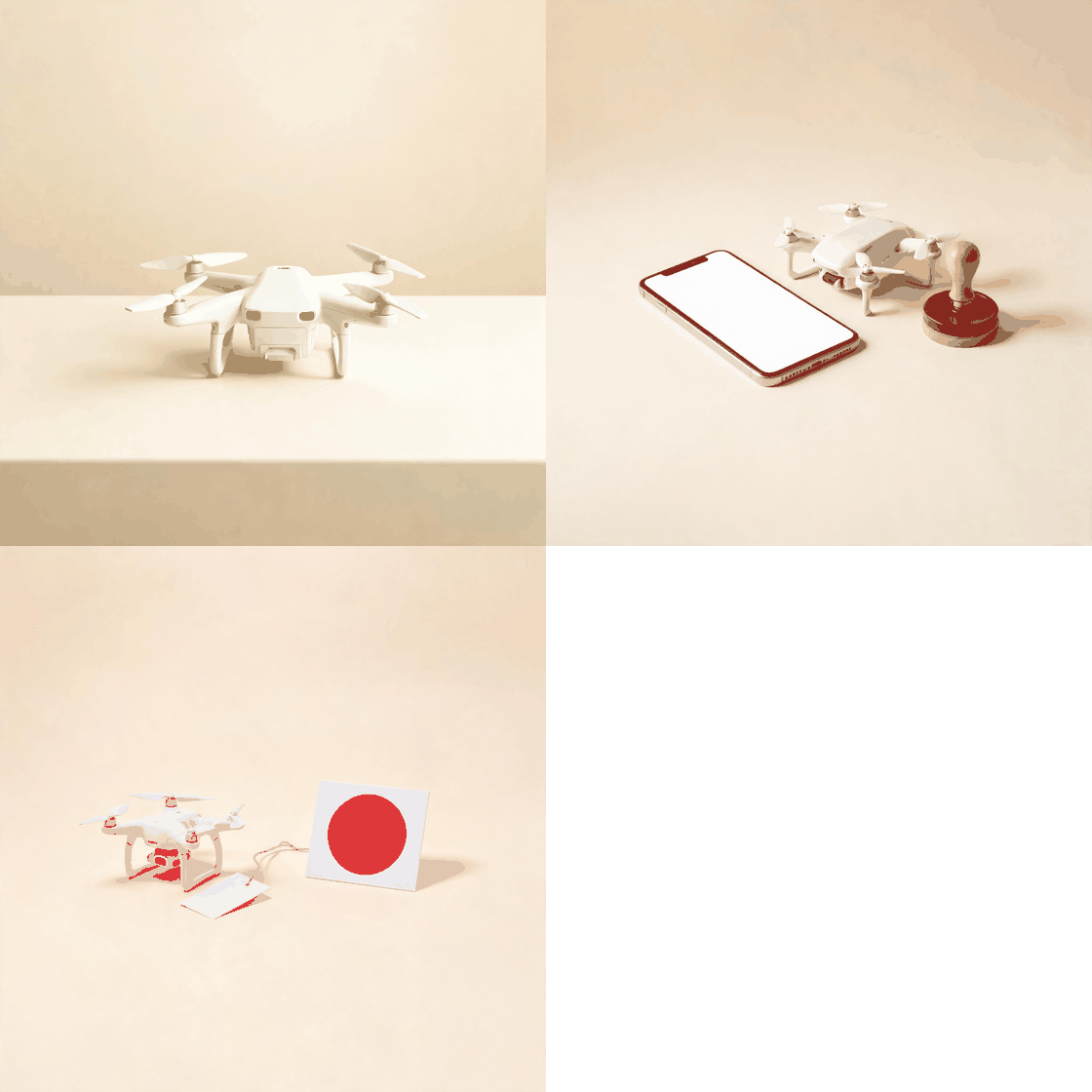
Registration is free and done online. Nationally it lives on the CAAC UOM platform (uom.caac.gov.cn) or its app and WeChat mini-program. In Shanghai you can do the whole thing through the 随申办 (Suishenban) app, in the "无人机飞行服务" mini-program: tap 添加无人机 to register the drone, then 我要飞行 to file a flight. You enter your name and ID, phone and email, the drone model and serial number, and the purpose, then pass a face check. The system issues a registration mark with a QR code, which you print at least 2cm by 2cm and stick somewhere obvious on the drone.
Expats are explicitly in scope: the official platform manual lists drones owned by foreign citizens, and a passport is a valid ID type. The real blocker for a short-stay visitor is not the paperwork, it is that finishing the identity check in practice wants a Chinese +86 mobile number and usually a WeChat account. If you live here, you already have both. If you are passing through, sort the phone number first.
Where you can fly: green zones and the 120-metre ceiling
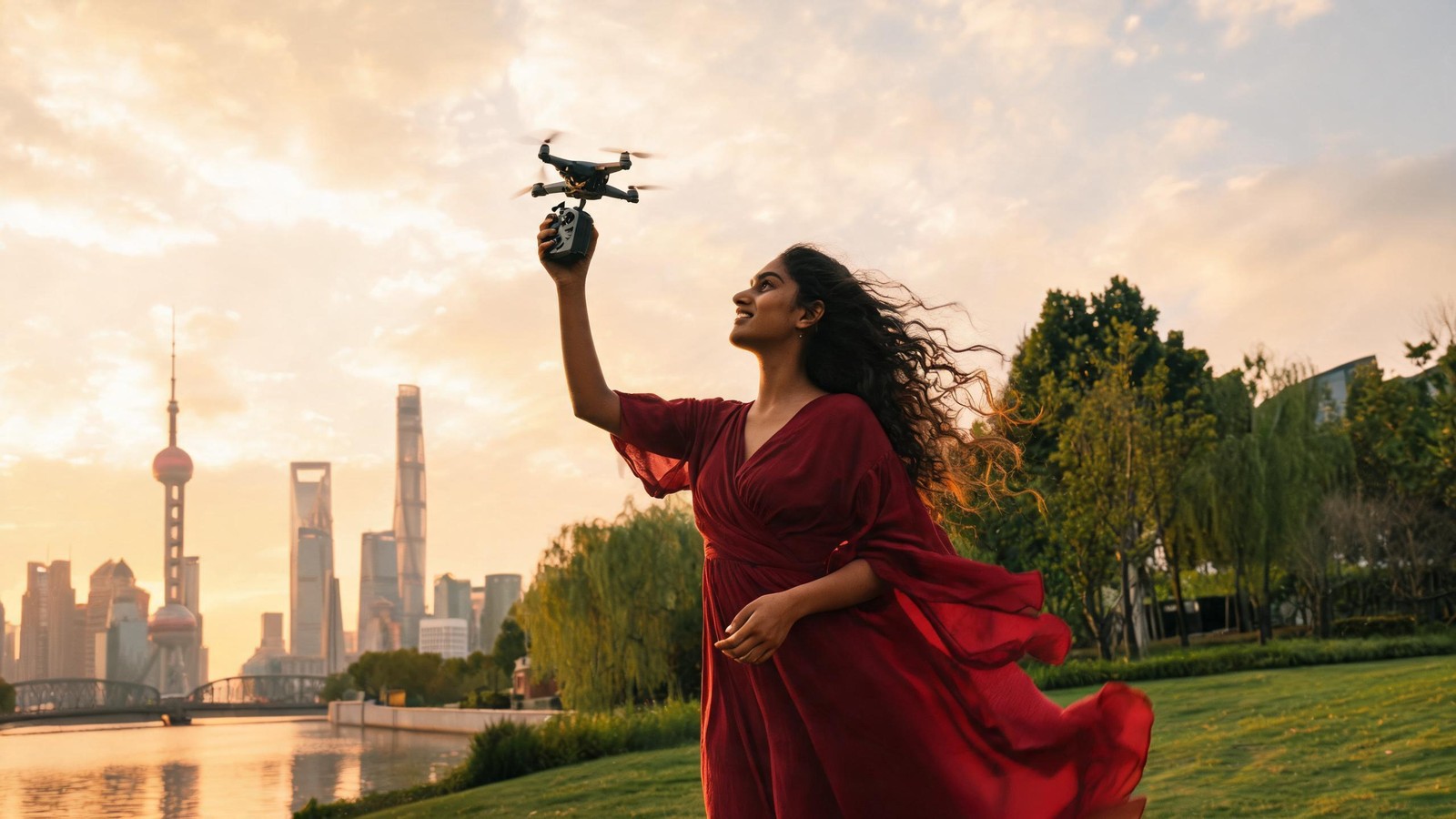
The default flyable space is the "suitable-flight" airspace (适飞空域): outside controlled zones, below 120 metres of real height. Inside a green zone, a registered micro, light or small drone needs no separate per-flight application. Everything else, including all airspace above 120 metres, is controlled.
Shanghai published its official green-zone map on 20 January 2026. Reporting suggests roughly 46 percent of the city is flyable, but the rest is not, and the "rest" includes the places you most want footage of. The obstacle zones around Pudong (PVG) and Hongqiao (SHA) airports reach deep into several Pudong towns and into Minhang and Changning. The Bund and other crowd magnets fall under controlled airspace and no-fly-over-crowds rules. Always check the live map in 随申办 before you fly, because the DJI app geofence alone does not match the local map. If you just want to fly for fun, Shanghai runs three free walk-up practice parks booked through the same app: World Expo Culture Park, Century Park and the Shanghai Botanical Garden.
Flying in controlled airspace: the day-before filing
You can fly in controlled airspace, but you have to ask in advance, and this is not a same-day decision. Submit the flight request through 随申办 by noon the day before. Air-traffic management replies by 21:00 that evening. On the day, the pilot confirms takeoff an hour before flying and confirms the landing afterwards. It is more planning than most casual flyers expect, which is exactly why the green zones exist: inside them, registration is all you need.
Penalties: fines, confiscation, and the new detention power
For an ordinary flyer the realistic exposure is modest on paper and sharper in person. Flying unregistered draws a fine up to 200 RMB (~USD 28) (up to 2,000 to 20,000 (~USD 280 to 2,800) in serious cases). Straying into controlled airspace without approval means an order to land plus up to 500 RMB (~USD 70), or in serious cases confiscation of the drone and 1,000 to 10,000 RMB (~USD 140 to 1,400). Flying a bigger drone without a pilot licence runs 5,000 to 50,000 RMB (~USD 700 to 6,900), though a typical consumer drone in a green zone needs no licence at all.
The part that changed the math: since 1 January 2026, a flight judged serious can also bring 5 to 10 days of police detention, and that sits on a separate track from the fine. A confiscated drone plus a detention record is a bad souvenir. The rules are not there to stop you flying, they are there to keep you out of the airport approach paths and off the top of a crowd.
Bringing one in, buying one here, and the battery rules
A personal drone is not a banned import. Customs generally treat it like a camera: they may inspect it or ask you to declare it, and there are scattered traveller reports of drones held at entry and returned on exit, so smooth entry is likely but not guaranteed. (Do not confuse this with China's drone export controls, which are a separate thing and do not apply to you carrying one in.) For the flight over, your LiPo batteries, all standard DJI Mini, Air and Mavic packs, are under 100Wh, which means they ride in the cabin only, never checked, up to about ten of them, and never if swollen. Buying a drone at a Shanghai DJI store skips the customs question entirely, but you still complete the same registration, plus activation from 1 May 2026, using the new unit's serial number.
Good to know
- Good for: anyone bringing or buying a consumer camera drone in Shanghai, from a sub-250g DJI Mini up to a Mavic. Unlike back home, sub-250g does not mean exempt here.
- What you need: the drone's serial number, your passport, and in practice a Chinese +86 mobile number and a WeChat account to finish the ID check. That phone step, not the form, is what stops most short-stay tourists. Registration itself is free.
- How to stay legal: register before you power on, fly only inside a blue green-zone below 120m real height, file by noon the day before for anything in controlled airspace, and steer clear of the Pudong and Hongqiao airport zones, crowds and the Bund. Check the live 随申办 map every time.
- The 2026 stakes: a serious illegal flight can now bring 5 to 10 days police detention plus fines and confiscation, and from 1 May 2026 new drones stay firmware-locked until registered and activated.
Sources · 资料来源
- State Council and Central Military Commission of China · 国务院、中央军委, Interim Regulations on the Administration of Unmanned Aircraft Flight (Order No. 761, in force 1 January 2024) · 无人驾驶航空器飞行管理暂行条例(国令第761号,2024年1月1日起施行), whose Article 10 requires real name registration of all civil drones · caac.gov.cn
- Civil Aviation Administration of China · 中国民用航空局 (CAAC), UAS Operation Management (UOM) real name registration platform · 民用无人驾驶航空器综合管理平台, where owners register drones of every weight, including sub 250g models · uom.caac.gov.cn
- Civil Aviation Administration of China · 中国民用航空局 (CAAC), official portal for civil aviation and unmanned aircraft rules · caac.gov.cn
- This is general guidance drawn from official sources, not legal or aviation advice. Rules on drone registration, restricted airspace, and flight approval change; confirm the current requirements with the Civil Aviation Administration of China before you register or fly.
Sun Tzu wrote 知己知彼,百战不殆, know yourself and know the other, and you are never in danger. With a drone that means knowing the airspace as well as you know your own aircraft, so the flight stays a pleasure and never becomes a report.
Is my sub-250g DJI Mini really not exempt?
Correct. The Mini is classified as light, not micro, because its radio exceeds the micro-power limit, so it needs real-name registration like any other camera drone. The true no-registration exemption only covers a genuine micro drone that meets the weight, height, speed and radio limits all together.
Can an expat register a drone here?
Yes. The official platform lists foreign owners and accepts a passport as ID. The practical hurdle is the identity check, which in practice wants a Chinese +86 number and a WeChat account, easy for residents, worth sorting early for visitors.
Do I need a pilot licence?
Not for a normal consumer drone flown in a green zone. A licence is only required for small-class drones and up. Most people flying a Mini or a Mavic for photos never need one.
Where can I actually fly without a headache?
Inside a green zone below 120 metres, or at one of Shanghai's three free practice parks (World Expo Culture Park, Century Park, Shanghai Botanical Garden), all booked through 随申办. Skip the Bund, the airports and any crowd.
What happens if I just fly quietly and hope?
Since 2026 that is a worse bet than it used to be. Most of the time nobody notices; but if they do, you are looking at a fine up to 500 RMB (~USD 70), a confiscated drone, and potentially 5 to 10 days of detention if the spot was sensitive. Ten minutes in the app is cheaper.