A mid-range wedding in Shanghai lands at roughly 100,000 to 200,000 RMB, and the banquet, not the dress, is where most of it goes.
Here is the thing nobody warns you about a Shanghai wedding: the dress is the romance, but the banquet is the bill. A mid-range celebration lands at roughly ¥100,000 to ¥200,000 (about USD 15,000 to 30,000), and one glorious night of feeding everyone you have ever met eats most of it. Keep the guest list honest and you can throw a warm, real wedding for ¥30,000 to ¥60,000 (about USD 4,500 to 9,000); say yes to a Bund ballroom and you will sail past ¥300,000 (about USD 45,000) without trying. Here is exactly where every yuan goes, plus the two old-world customs, the gold and the bride price, that quietly ambush couples when one half is local.
Good to know
- Typical spend: ¥100,000 to ¥200,000 (about USD 15,000 to 30,000) for a mid-range hotel banquet wedding.
- Biggest cost: the banquet, usually 60 to 70 percent of the whole bill.
- Make the most of it: lock the venue and date first, keep the guest list honest, and remember guests' red envelopes (even amounts only, about ¥2,000 a head here) claw a real chunk of the banquet back.
What a Shanghai wedding really costs, all in
A Shanghai wedding costs exactly as much as your guest list and your venue decide, and the spread is dizzying, from an intimate supper to a five-star blowout on the Bund. Two numbers quietly rule all the others: how many tables you fill and how glamorous the room is. Settle those two and your budget is more or less already written. The three bands:
| Scale | All-in cost (RMB) | In US dollars |
|---|---|---|
| Small & intimate (few tables, DIY) | ¥30,000 to ¥60,000 | USD 4,500 to 9,000 |
| Mid-range (hotel banquet, planner) | ¥100,000 to ¥200,000 | USD 15,000 to 30,000 |
| Lavish (five-star, large guest list) | ¥300,000-plus | USD 45,000-plus |
Note the gap between the tiers is almost entirely the venue and the headcount. Everything else, photos, planners, cars, moves far less. So if you want to control the number, control the room and the guest list first.
Why the banquet eats most of the budget
This is where the money really vanishes. The banquet (酒席) swallows 60 to 70 percent of the budget, because a Shanghai wedding is, at heart, a gorgeously staged dinner for everyone you know. Hotels sell it by the table of ten, and a mid-range ballroom runs roughly ¥3,500 to ¥5,600 (about USD 520 to 840) a table. Fill the fifteen to twenty tables a normal wedding needs and the feast alone is ¥70,000 to ¥110,000 (about USD 10,400 to 16,400), before a single peony.

A restaurant private room undercuts a hotel ballroom for the same crowd, and a weekday or a lunch sitting is far gentler than Saturday night. Your real lever is the headcount: every table you quietly trim is a few thousand yuan back in your pocket, and it is the one cut nobody at the wedding ever feels.
Photos, planners and the four heavenly kings
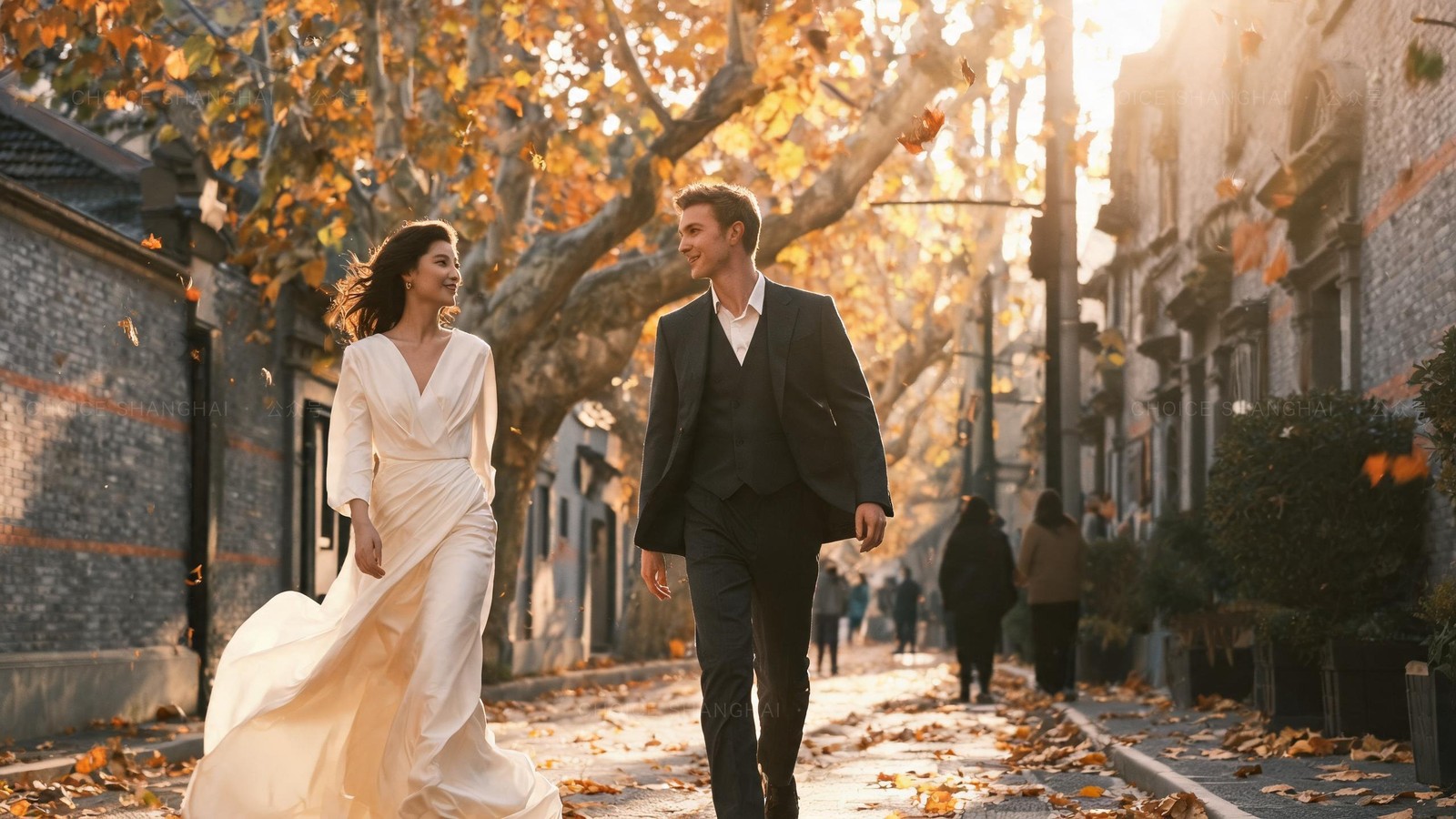
Away from the feast, four pretty line items do the rest of the damage, and none of them has to hurt. Those swoony pre-wedding photos (婚纱照), the ones that quietly colonise everyone's WeChat Moments, run ¥8,000 to ¥20,000 (about USD 1,200 to 3,000) for a local studio; a planner with styling and decor (婚庆) adds ¥20,000 (about USD 3,000) and up; the day-of "four heavenly kings" (sida jingang, 四大金刚), your MC, makeup artist, photographer and videographer, land around ¥10,000 (about USD 1,500); and a fleet of ribboned wedding cars is roughly ¥5,000 (about USD 750). Here is the whole shape of it, next to the banquet.
| Line item | Cost (RMB) | In US dollars |
|---|---|---|
| Banquet (15 to 20 tables) | ¥70,000 to ¥110,000 | USD 10,400 to 16,400 |
| Pre-wedding photos | ¥8,000 to ¥20,000 | USD 1,200 to 3,000 |
| Planning & decor | ¥20,000-plus | USD 3,000-plus |
| Four essentials (MC, makeup, photo, video) | around ¥10,000 | around USD 1,500 |
| Wedding cars | around ¥5,000 | around USD 750 |
| Honeymoon | ¥10,000 to ¥50,000 | USD 1,500 to 7,500 |
The honeymoon (蜜月) sits apart from the wedding day but couples budget it together; a domestic trip runs ¥10,000 to ¥30,000 (about USD 1,500 to 4,500) and going overseas can push past ¥50,000 (about USD 7,500). None of these four are where a wedding quietly balloons; the banquet is.
Gold, bride price and the debate it sparks
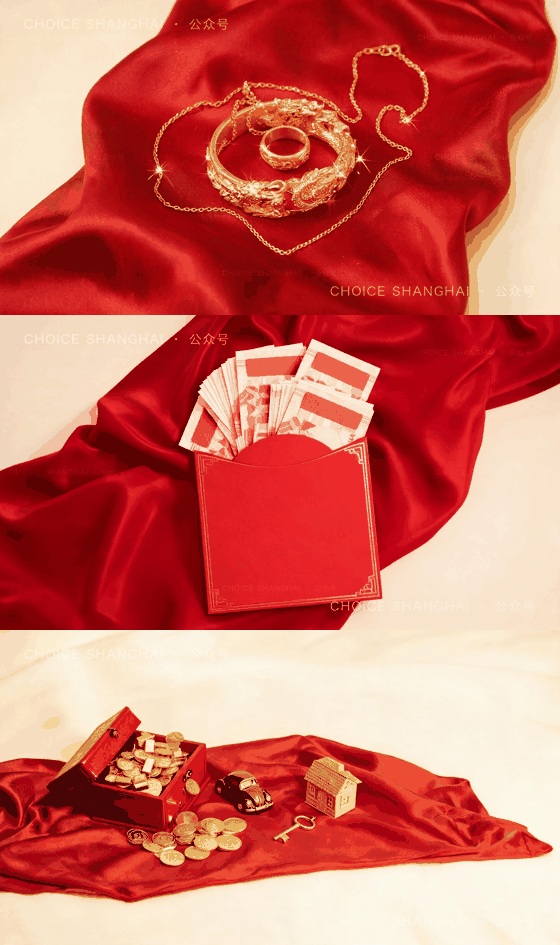
Two old-world customs tend to blindside couples where one partner is local, and both live outside the banquet budget. First, the "three golds" (sanjin, 三金), a gold ring, necklace and bracelet the groom's family presses on the bride, usually tens of thousands of yuan and climbing with the gold price. Second, the bride price (caili, 彩礼), a sum that travels from the groom's family to the bride's.

Bride price is the custom that sets the Chinese internet alight, usually argued as whether a groom should pay it at all, and the debate runs hot: to its critics it looks transactional, even mercenary; to its defenders it is the one piece of security a woman gets in a system that offers little else. The fuller picture is more balanced than the shouting. Caili (彩礼) rarely moves one way: the bride’s family traditionally sends back a peijia (陪嫁, dowry) of its own, often matching or outstripping the caili in cash, gold, a car, sometimes a flat, so what looks like a price is closer to two families jointly staking the new household. Shanghai, by national standards, is refreshingly relaxed about all of it: local families often treat marriage as an equal partnership, some skip the caili entirely, and where it is exchanged, from tens of thousands to over ¥100,000 (about USD 15,000), it usually lands back with the couple as a cushion for the new home.
It helps to know what the custom is actually for, because that is the part the shouting skips. Historically the caili acknowledged that a bride would spend her life running a household with no income of her own. The modern logic is quieter but just as real: a woman’s career and earnings take the hit when she has a child, and the state cushion for that is thin, a national childcare subsidy of roughly ¥3,600 a year per child under three (about USD 500, or ¥300 a month), a few cities adding a little, set against a birth rate now among the world’s lowest. The law sharpens it. Under the Civil Code, the flat or car a partner bought before the wedding stays legally theirs however long the marriage lasts, with only limited compensation at a judge’s discretion; and while income earned during a marriage is shared in principle, how much actually reaches a wife at home with a baby often rests on a husband’s goodwill rather than any rule. Seen that way, many families treat the caili less as a fee than as the wife’s own security, money that stays with her, for the years she is raising a child with little else to fall back on.
None of this is settled, which is rather the point: it sits right on top of a national worry about why so few couples are starting families, and how little the system still does for the women who do. The courts are less one-sided than the resentment assumes. Since a 2024 Supreme Court rule, a caili can be clawed partly back to the groom’s side when a marriage was short or never really began; and a peijia, once it has changed hands, is usually absorbed into the new household, shared with the husband’s side rather than kept by the bride alone, unless her family clearly earmarked it for her. And yet caili is still one of the internet’s most resented customs, which tells you the argument was never only about the money. For a couple, then, the move is not to win it but to have it, kindly and early, together, before either set of parents names a figure. These are family conversations, not price tags, and the same care applies to what you give and never give at any Chinese celebration. If you have not registered the marriage yet, the paperwork is a separate matter (two foreign nationals cannot register in Shanghai at all).
One scope note: all of this is about ordinary marriages and the customs around them. Marriage fraud and sham marriages are a separate, criminal matter that this piece does not touch.
Do the red envelopes cover the bill?
Partly, and it is the line couples always forget to count. Guests arrive with cash tucked into a red envelope (fenziqian, 份子钱), and Shanghai runs generous: a single guest here typically gives around ¥2,000 (about USD 300), and it climbs the closer you are. One rule is non-negotiable, and it catches every newcomer once: the amount is ALWAYS an even number (双数), because happiness is meant to arrive in pairs (好事成双); odd sums are for funerals. And never a figure with a 4 in it, since 四 (four) echoes 死, the word for death. Warm, generous, even numbers like ¥800, ¥1,200, ¥1,600 and ¥2,000 are the safe, lovely choices, and the dearer the friendship, the higher you go.
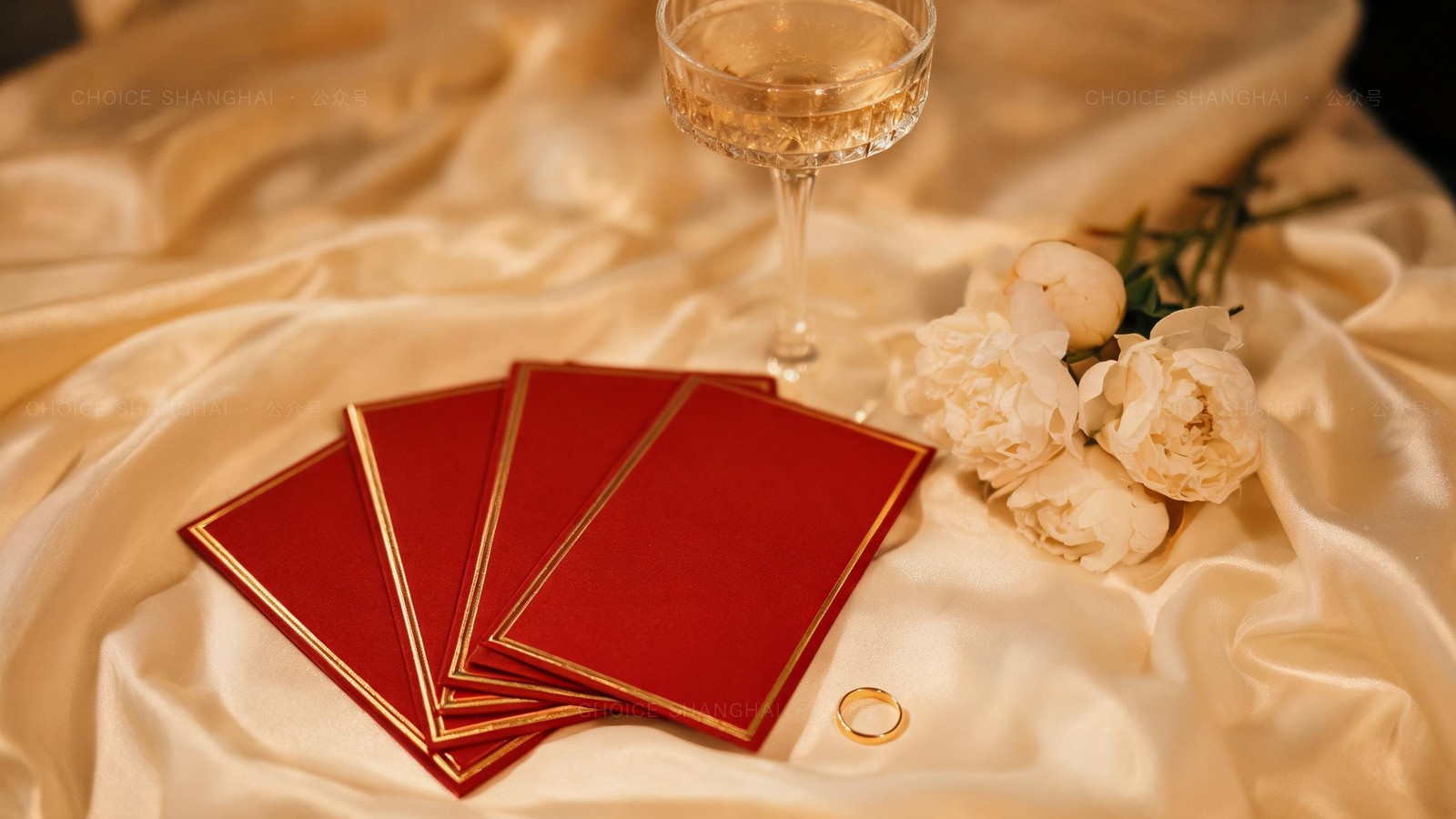
Across a 150-guest wedding those envelopes can claw back a real slice of the banquet, sometimes close to half, so your true out-of-pocket cost is friendlier than the sticker total. But do not spend it before it lands. The haul depends entirely on who shows up and how close they are, it usually arrives long after the deposits are paid, and treating it as guaranteed income is exactly how couples overcommit. Budget as if it covers a third, and let the rest be a happy surprise.
What to splurge on, and what to skip
Want a wedding that feels lavish without the ¥200,000 (about USD 30,000) bill? Spend on what guests actually remember and quietly cut what they do not. Keep a generous banquet and a real photographer, because those two ARE the day. Then trim the guest list, steal a weekday or lunch slot, and let go of the elaborate decor package and the second costume change if money is tight. Give the honeymoon its own timeline so it never has to arm-wrestle the deposits.
If you are the couple who wants one unforgettable room and the bill be damned, book the Bund hotel, invite everyone, and let the red envelopes soften the landing. If you would rather pour it into the flat instead, do the intimate restaurant version, invite only the people who truly matter, and spend the difference on the life that starts the next morning.
A last word
We just spent a whole guide counting what a wedding costs, so let us be honest about what it is worth: the numbers are never really the point. Take away the gold, the banquet and the arguments over caili, and a wedding is two people choosing to love and be loved, which is, at the far end of a life, about the only thing any of us is doing here. The money and the shine are not what you will want to look at from there. The faces are.
Real love, a real family, is not the easy option or the cheap one. It asks for sacrifice and patience, for giving more than you knew you had, over and over. Plenty of people never find it, or quietly choose not to, and build a full, good, solitary life instead, and that is not a smaller life or a wrong one. Having known both the loneliness and the quiet, startling worth of being truly loved, we would give everything for our people, and we understand that your road may run another way. There is no right answer here. There is only your choice, and it is yours to make.
So whatever you spend, and on whomever, we wish you the clear-eyed kind of love, the one that knows what it is for. 愿你终能看清心中所爱,也终被温柔以待。
The Book of Changes has a line couples still quote at weddings, 二人同心,其利断金, when two people are of one heart, their strength can cut through metal.
How much does a wedding in Shanghai cost in 2026?
A mid-range hotel-banquet wedding costs about ¥100,000 to ¥200,000 (USD 15,000 to 30,000). A small, intimate wedding can be done for ¥30,000 to ¥60,000, and a lavish five-star affair runs past ¥300,000, with the banquet always the largest single line.
How much is a wedding banquet per table in Shanghai?
A mid-range Shanghai hotel charges roughly ¥3,500 to ¥5,600 (about USD 520 to 840) per table of ten. A typical wedding hosts fifteen to twenty tables, so the banquet alone comes to ¥70,000 to ¥110,000. Restaurants and weekday or lunch slots cost less than a Saturday-night ballroom.
How far ahead should you book a wedding venue in Shanghai?
Six to twelve months out for a good hotel ballroom, and longer for a popular weekend or an auspicious double-digit date near a holiday, when the standout rooms go first. The banquet date drives the whole plan, so lock it before anything else. Booking early also pins the per-table price before the following year’s menus rise.
Do you have to pay bride price to marry in Shanghai?
No, it is a family custom, not a legal requirement, and Shanghai is relatively relaxed about it. Some local families skip the caili (彩礼) entirely, others exchange a symbolic sum from tens of thousands up, which often returns to the couple. Discuss it early with both families rather than assuming a figure.
Words, maps and research by the Choice Shanghai team. Please credit us and tag our 公众号 if you share.