
The HSK is China's official Chinese-language exam, and you sit it in Shanghai at a university centre or online.
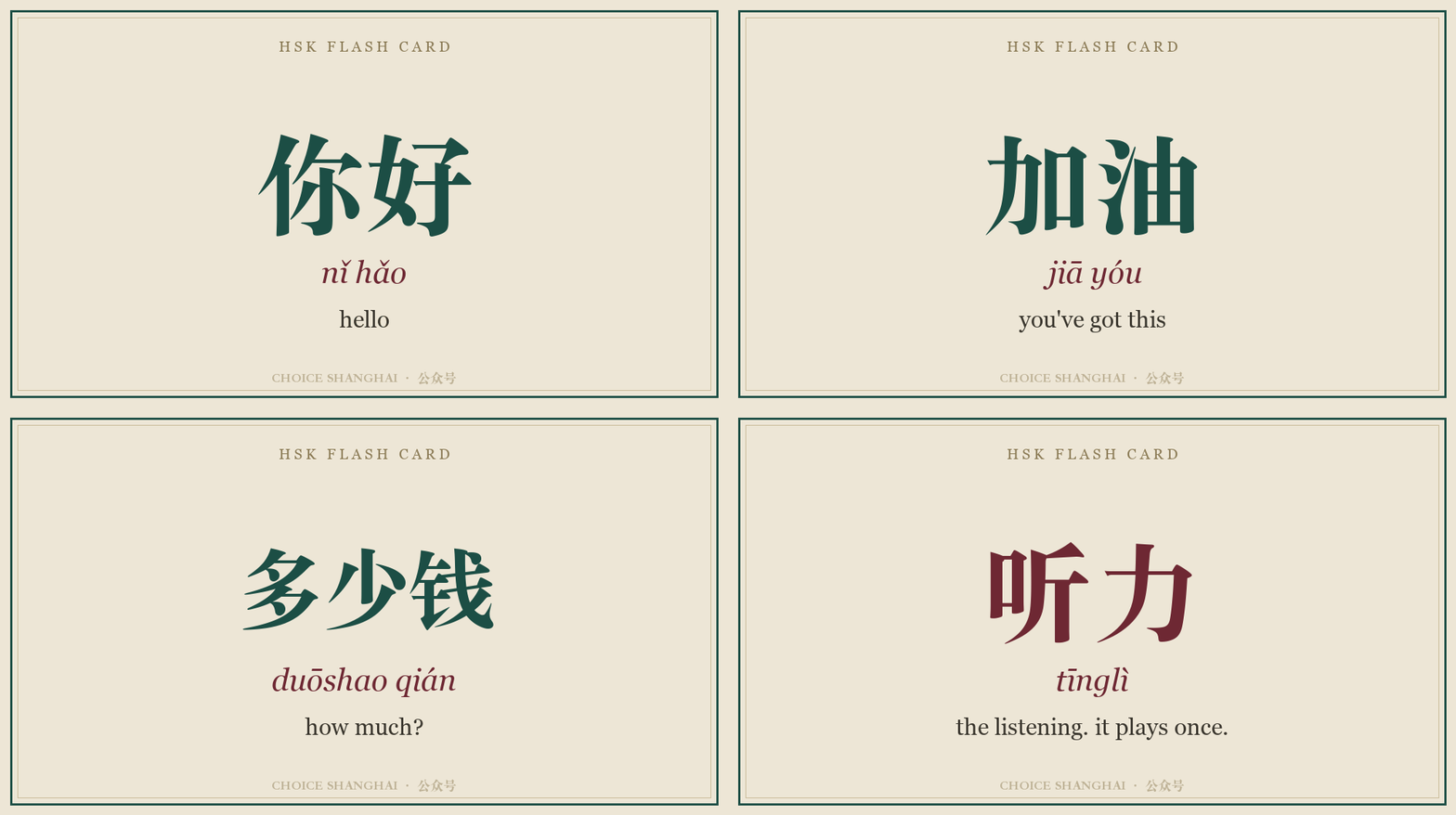
Here is the whole thing in one breath: in Shanghai you sit the HSK at a university centre or at home with a webcam, you book it yourself on the official site chinesetest.cn, and the fee runs ¥150 to ¥650 (about USD 22 to 97) by level. One warning the forums all repeat, the listening plays exactly once, faster than any practice tape. Everything else rewards ordinary, deadline-driven study. For the classes and tutors that get you there, see our guide to learning Mandarin in Shanghai.
Good to know
- Good for: learners who need a certificate for study, a job or visa points, or simply a firm deadline to study toward.
- Register on: chinesetest.cn, the official site, not through your school, with one account per email address.
- Formats: paper at a centre, computer at a centre, or from home with a webcam, depending on the date you pick.
- Book early: registration closes roughly 27 days before a paper sitting and about 10 days before a computer-based one, and Shanghai dates fill.
- Results: land about 30 days later in your chinesetest.cn account.
- Speaking is a separate test: the spoken HSKK has its own fee, and for HSK 3 and up your booking may ask you to register for it at the same time, so check on chinesetest.cn.
What the HSK is, and why a deadline helps
The HSK (汉语水平考试) is the standard Mandarin exam that mainland universities, employers and visa offices recognise. It tests reading and listening, with writing from the middle levels up; speaking is a separate test, more on that below. People sit it for three reasons. For a visa, Shanghai's work-permit points system gives up to five points for Mandarin, with HSK 5 and above worth the full five, so it is a useful top-up rather than the thing that decides your permit. For a job, plenty of people only booked once a manager asked for a number. And for themselves: a date turns "I should study" into "I have six weeks," which is often how the language stops being a wall.

HSK 2.0 or the new 3.0? What you actually book in 2026
Short version, do not panic: in 2026 you almost certainly still book the familiar six levels, HSK 1 to 6. The reform you have heard about, HSK 3.0, is real but arriving in stages. It rebuilds the exam into nine levels across three bands, and the advanced 7 to 9 band has run since 2022. The restructured 1 to 6 version was trialled worldwide in January 2026, but the everyday Shanghai sitting is still the six-level test, known informally as HSK 2.0, alongside the separate HSKK. The format can still vary by centre, so confirm the version, level and date on chinesetest.cn before you pay. This is simply the year the old and the new overlap.

What the HSK costs in Shanghai
The written fee climbs by ¥100 (about USD 15) a level: ¥150 for HSK 1 up to ¥650 for HSK 6, paid online the moment you register. The spoken HSKK runs on its own scale, ¥200 to ¥600 (about USD 30 to 90), so if an application wants both a written and a spoken score, budget for two exams.
The index HSK written levels and fees in mainland China, 2026 | |||
|---|---|---|---|
| Level | Vocabulary | What it proves | Fee |
Beginner HSK 1 | ~150 words | Basic survival words and set phrases | ¥150 USD 22 |
Beginner HSK 2 | ~300 words | Simple everyday exchanges | ¥250 USD 37 |
Elementary HSK 3 | ~600 words | Getting by in daily life and travel | ¥350 USD 52 |
Intermediate HSK 4 | ~1,200 words | Comfortable conversation, work-ready Mandarin | ¥450 USD 67 |
Upper-intermediate HSK 5 | ~2,500 words | Reading news, near-professional range | ¥550 USD 82 |
Advanced HSK 6 | 5,000+ words | Academic-level reading and writing | ¥650 USD 97 |
| Registration fee CHOICE · SHANGHAI | |||
One rule worth the whole section: do not pay for the level above the one you can pass cleanly. A confident HSK 4 reads better than a shaky HSK 5 you scraped through.
Where you sit it, and how to register without tripping up
Shanghai's centres are mostly universities: Tongji, Shanghai Normal for paper sittings, Shanghai Maritime out in Lingang for internet-based ones, and the language-heavy Shanghai International Studies University. Each offers only a handful of dates a year, so the reliable move is the Test Centers finder on chinesetest.cn: filter to Shanghai and it shows which centre has your date, in the format you want, with the address to turn up to.
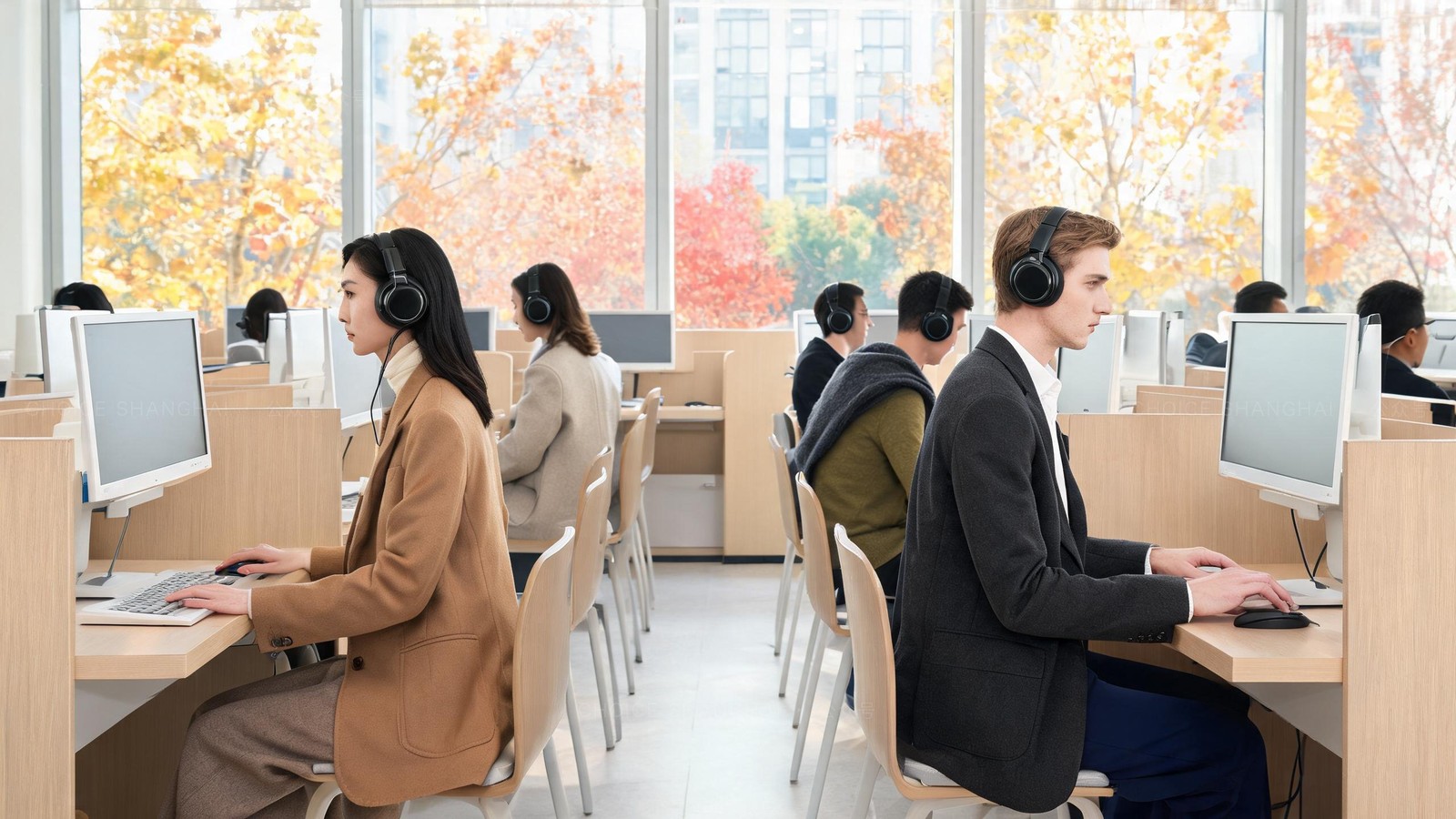
Register on that site, not through your school. One account per email, a plain passport-style photo (colour, bareheaded, white background, nothing AI-smoothed), then pick your level, date and centre and pay; the booking is not valid until payment clears. Two things catch people every season: the good Shanghai dates vanish within days, and the photo gets bounced for the faintest shadow or a hint of a smile. Registration closes roughly 27 days before a paper sitting and about 10 before a computer one, and results post to your account about a month later. Bring your passport, with the name and birth date matching your registration exactly.
The speaking test, HSKK, that almost nobody mentions
The HSKK (汉语水平口语考试) trips people up because it is genuinely its own test, with its own fee and its own recording, not the speaking half of the written HSK. Three bands, beginner, intermediate and advanced; audio-recorded rather than a live interview; scored out of 100 with 60 to pass. For years most learners simply skipped it, one reported knowing just two people in six years who had sat it. That is changing: under 3.0, speaking is tied more tightly to each level, and for HSK 3 and up your booking may ask you to register for the matching HSKK at the same time, so check what your sitting includes when you book.
Which HSK level is right for you
Three rules settle almost every case. Aim at the level an employer or university has actually named, not the most impressive number. Never pay for a level above the one you can pass cleanly. And if an application asks for a spoken score, add the matching HSKK rather than assuming the written result covers it. Match the certificate to the door you are trying to open, book that sitting, and ignore the rest of the noise.
What is the pass mark for the HSK?
HSK 1 and 2 need 120 out of 200, and HSK 3 to 6 need 180 out of 300, which is 60 percent. Whether each section must separately clear that line is reported inconsistently, so treat your overall score as the number that counts and aim comfortably above it.
How long is an HSK certificate valid?
The certificate does not expire for many purposes, but institutions commonly treat a score as current for about two years. That two-year figure is widely repeated rather than something we could confirm on an official page, so check the exact window with the university or employer you are submitting it to.
Can I sit the HSK online from home?
For some dates, yes. Shanghai offers internet-based sittings you take on your own computer with a webcam and a steady connection, alongside the paper and computer-at-a-centre options. Online dates are limited and fill quickly, and some universities and employers still prefer a centre-sat result, so confirm an at-home score will be accepted before you choose that format.
Which HSK level do employers in Shanghai expect?
It depends entirely on the role. Many jobs aimed at international hires ask for no HSK at all, while positions where Mandarin is the working language usually want HSK 4 or 5, with HSK 5 the level most employers read as professional working ability. Check the specific listing rather than a general rule.
Sources · 资料来源
- Center for Language Education and Cooperation / 中外语言交流合作中心 (CLEC), which administers the HSK and HSKK and runs registration, fees and results, 2026. chinesetest.cn
- Ministry of Education and State Language Commission / 教育部 · 国家语言文字工作委员会, Chinese Proficiency Grading Standards for International Chinese Language Education (GF0025-2021), the three-band nine-level standard behind HSK 3.0, in force 1 July 2021.
- Beijing municipal government English portal / 北京市人民政府, notice on the HSK 3.0 trial of levels 1 to 6 held 31 January 2026 across 168 countries, December 2025. english.beijing.gov.cn
- Shanghai municipal government English portal / 上海市人民政府, 2026 study-in-Shanghai HSK notice. english.shanghai.gov.cn
As Confucius opens the Analects, 学而时习之,不亦说乎, to learn and then practise what you have learned in season, is that not a joy. The exam is only the milestone. The joy is the ordinary day in Shanghai when the language stops being a wall.
Words, maps and research by the Choice Shanghai team. Please credit us and tag our 公众号 if you share.