I wasn’t a coffee person when I moved to Shanghai. The city fixed that within a month.
I wasn’t a coffee person when I moved to Shanghai. The city fixed that within a month.
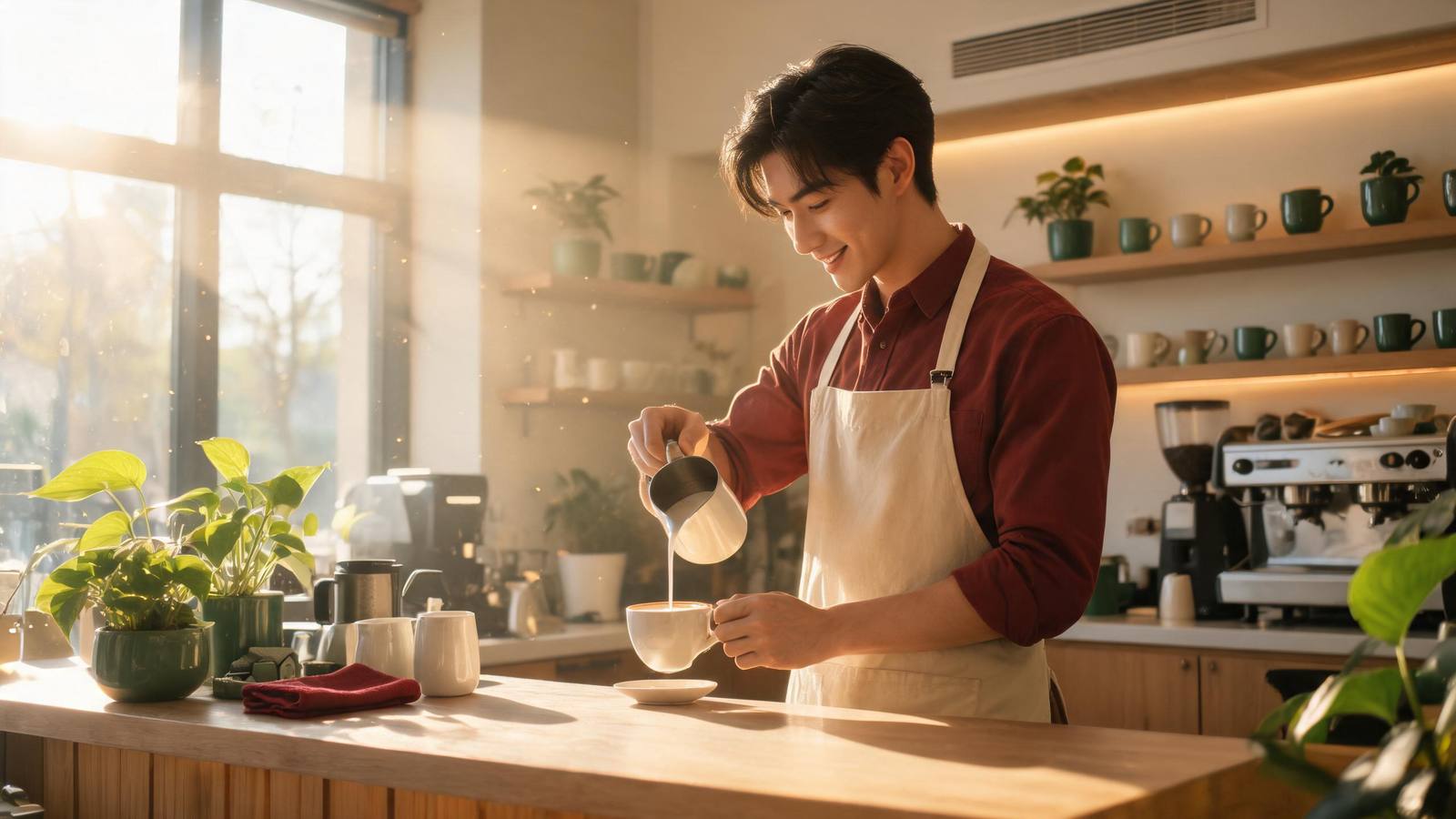
It started with a Manner on my morning commute: a hole-in-the-wall counter, no seating, just a barista pulling shots with a focus you usually reserve for surgery. 15 RMB for a latte that tasted like something a Melbourne roaster would charge triple for. I didn’t understand how the math worked. I still don’t. But I stopped questioning it around my 400th cup.
What makes Shanghai’s coffee scene different from other “coffee cities” is that it doesn’t feel exclusive. There’s no gatekeeping. You can get an award-caliber pour-over next to a street selling scallion pancakes, in a renovated shikumen lane house, for the price of a vending machine coffee back in London. The city didn’t build a coffee scene for enthusiasts. It built one for everyone, and the enthusiasts showed up after. The scale is not a rumor: more than 10,000 coffee shops operate here as of 2026, more than any other city on earth, according to the China Urban Coffee Development Report, and most of them are both independent and genuinely good.
Xuhui & Huangpu: the classic crawl
If you only have one afternoon for Shanghai coffee, spend it here. The tree-lined streets around Yongkang Lu, Changle Lu, and Wulumuqi Lu are where the city’s specialty coffee culture started, and it’s still the densest concentration of quality cafes anywhere in the city.
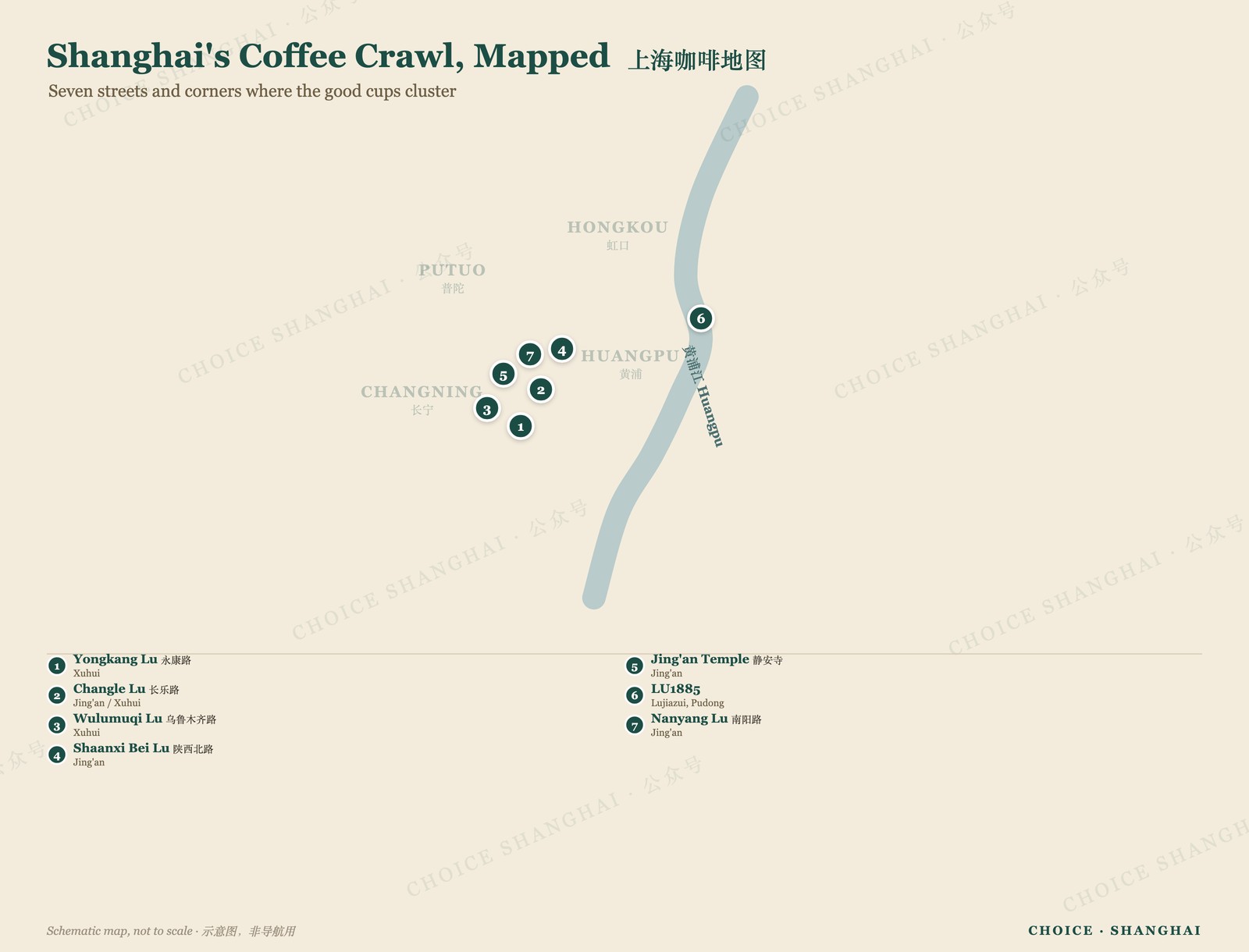
What to know: The cafe density in parts of Huangpu and Xuhui exceeds 38 shops per square kilometer. You can walk three blocks and hit five specialty roasters without trying. The challenge is not finding coffee here. It’s choosing.
The vibe: Tree-lined streets, repurposed lane houses, courtyard seating under plane trees. This is where Instagram-worthy cafes live, but the ones here earn the attention with what’s in the cup, not just the decor.
Order this: A single-origin pour-over at any roaster that displays its beans by region. If they’re sourcing Yunnan beans (many are), you’re tasting something that literally cannot exist anywhere else: Chinese-grown specialty coffee, processed in China, served in a lane house built in the 1930s.
My coffee walk when friends visit: start on Yongkang Lu with a flat white, drift down to Changle Lu for something iced, finish on Wulumuqi Lu with a pour-over at wherever has the shortest line. Total damage: about 90 RMB, three cafes, two hours, and a caffeine level your doctor would politely question. It’s a standout walking tour in the city, and you don’t need a ticket.
Jing’an: the workhorse neighborhood
If the Xuhui cafe strip is where you go to photograph coffee, Jing’an is where you go to drink it. This neighborhood runs on caffeine in a practical, no-performance way. Freelancers at laptops, office workers grabbing a quick pour between meetings, retired locals reading newspapers over a long Americano.
What to know: Shaanxi Bei Lu and the streets around Jing’an Temple have a high concentration of local specialty chains (Manner, Seesaw, M Stand) alongside independent roasters. It’s also where you’ll find some genuinely inventive seasonal drinks, because these cafes are competing for daily regulars, not tourists.
The vibe: Less photogenic, more functional. Expect smaller spaces, counter-only service, and baristas who remember your order. This is workday coffee culture.
Order this: Whatever the seasonal special is. Jing’an cafes rotate their menus aggressively. In summer, expect coconut cold brews, osmanthus lattes, and espresso tonics with citrus. If you see a drink with lychee or jasmine in July, try it. These seasonal combos rarely survive more than a few weeks.
Pudong: the quiet revolution
Pudong coffee used to be a punchline: hotel lobby espresso and Starbucks in the financial district. That’s no longer true.
What to know: The opening of LU1885 in May 2026 brought a cluster of specialty coffee and bar concepts to the Lujiazui area, anchored around a restored heritage villa. It’s not the volume of Puxi, but the quality has arrived.
The vibe: More polished, more spacious. Pudong cafes tend to have actual room to sit, which in Shanghai coffee terms is a luxury. If you live or work east of the river, you no longer need to cross for good coffee.
Order this: An Amaro-style coffee cocktail at one of the new LU1885 concepts, or a classic flat white at any of the growing number of independent shops in Lujiazui. The game has changed here.
Changning and Putuo: the locals’ picks
These residential neighborhoods don’t make global coffee lists. They should.
What to know: Changning and Putuo are where many long-term expats and locals actually live. The cafes here aren’t designed for foot traffic or social media. They’re built for neighbors. Prices are 20-30 percent lower than the Xuhui cafe strip for comparable quality, and you’ll almost never wait for a seat.
The vibe: Quiet. Familiar. The barista knows the regulars. There’s usually a cat. The furniture doesn’t match. This is what coffee culture looks like when it’s not performing for anyone.
Order this: A simple latte or Americano. These shops win on execution, not novelty. If the basics are good here, everything else follows.
I live in Putuo. My neighborhood has three specialty coffee shops within a five-minute walk, none of which appear on any English-language list. The latte at my regular place costs 18 RMB. The barista once texted me because they got a new single-origin Yunnan in and thought I’d want to try it. This is what 10,000 coffee shops actually looks like at street level: not a scene, but a relationship.
The homegrown brands worth knowing
Shanghai didn’t just import coffee culture. It built its own, and the brands that came out of this city are now reshaping how China drinks coffee.
Manner started as a 2-square-meter window on Nanyang Lu. Now it’s a nationwide specialty chain, and the latte is still 15 RMB. The quality-to-price ratio is borderline suspicious.
Seesaw was one of the first to spotlight Yunnan-grown beans, treating Chinese coffee not as a curiosity but as a genuine origin worth exploring. Their seasonal menu is always worth checking.
M Stand turned coffee into a lifestyle brand with flagship stores that feel more like design galleries. The coffee is solid. The spaces are memorable.
And then there are the individuals: baristas like Captain George (Peng Jinyang), who won the 2025 World Brewers Cup championship. Shanghai doesn’t just consume coffee at scale. It competes at world level.
Shanghai Coffee: A Practical Cheat Sheet
- Prices as of August 2026.
- Budget-friendly daily coffee: Manner or any local chain, 15-25 RMB for a latte. The quality punches well above the price.
- Specialty experience: Independent roasters around Yongkang Lu or Jing’an, 30-50 RMB for a pour-over or signature drink. Ask what’s freshly roasted that week.
- Summer move: Order iced. Shanghai baristas take iced drinks seriously, with dedicated recipes, not just hot coffee over ice. Coconut cold brew, espresso tonic, and fruit-infused cold brews are everywhere in July.
- Payment: Nearly all cafes are cashless. WeChat Pay and Alipay are standard. A few accept international cards, but don’t count on it.
- Cafe etiquette: No minimum spend culture at most independent cafes. Laptop-friendly spots usually have Wi-Fi passwords on the receipt or the wall. Just order something every couple of hours if you’re camping out.
- go-to time to visit cafes: Weekday afternoons, 2-4pm. Weekend mornings at popular spots mean queues. Tuesday at 3pm? Just you and the barista.
Which neighbourhood is for you
If you have one afternoon and want the postcard crawl, start in Xuhui around Yongkang Lu. If you work at a laptop and want to be left alone, Jing'an is the workhorse. If you live east of the river, Pudong finally rewards staying put. And if you want the 18 RMB latte and the barista who remembers your order, go where the locals go in Changning or Putuo. As of August 2026, all four are a short Metro ride apart.
Frequently asked
Why is Shanghai called the coffee capital of the world?
Over 10,000 coffee shops as of 2026, more than any city globally including New York and London, according to the China Urban Coffee Development Report. Homegrown brands like Manner, Seesaw, and M Stand started here and went national. The cafe density in some neighborhoods exceeds 38 per square kilometer. Shanghai hosts barista champions who compete at the world level.
What is a standout coffee neighborhood in Shanghai?
Start in Xuhui: the tree-lined streets around Yongkang Lu and Changle Lu hold the densest concentration of specialty cafes, and Jing’an is catching up fast. If you want a classic cafe crawl, choose Xuhui; if you want something more experimental, head to newer areas like Yangpu, where the adventurous roasters are opening.
How much does coffee cost in Shanghai?
As of August 2026, a latte at Manner runs 15 to 25 RMB. Here is how the tiers compare:
| Where | Typical order | Price (RMB) |
|---|---|---|
| Manner and local chains | Latte | 15 to 25 |
| Independent specialty roasters | Pour-over or signature | 30 to 50 |
| International chains | Latte | 35 to 45 |
Compared with most global cities, Shanghai specialty coffee stays remarkably affordable for the quality.
As the Book of Han records, 民以食为天, to the people, food is heaven. A city shows itself in its daily rituals, and a morning cup poured with real care is a small act of faith repeated ten thousand times over.