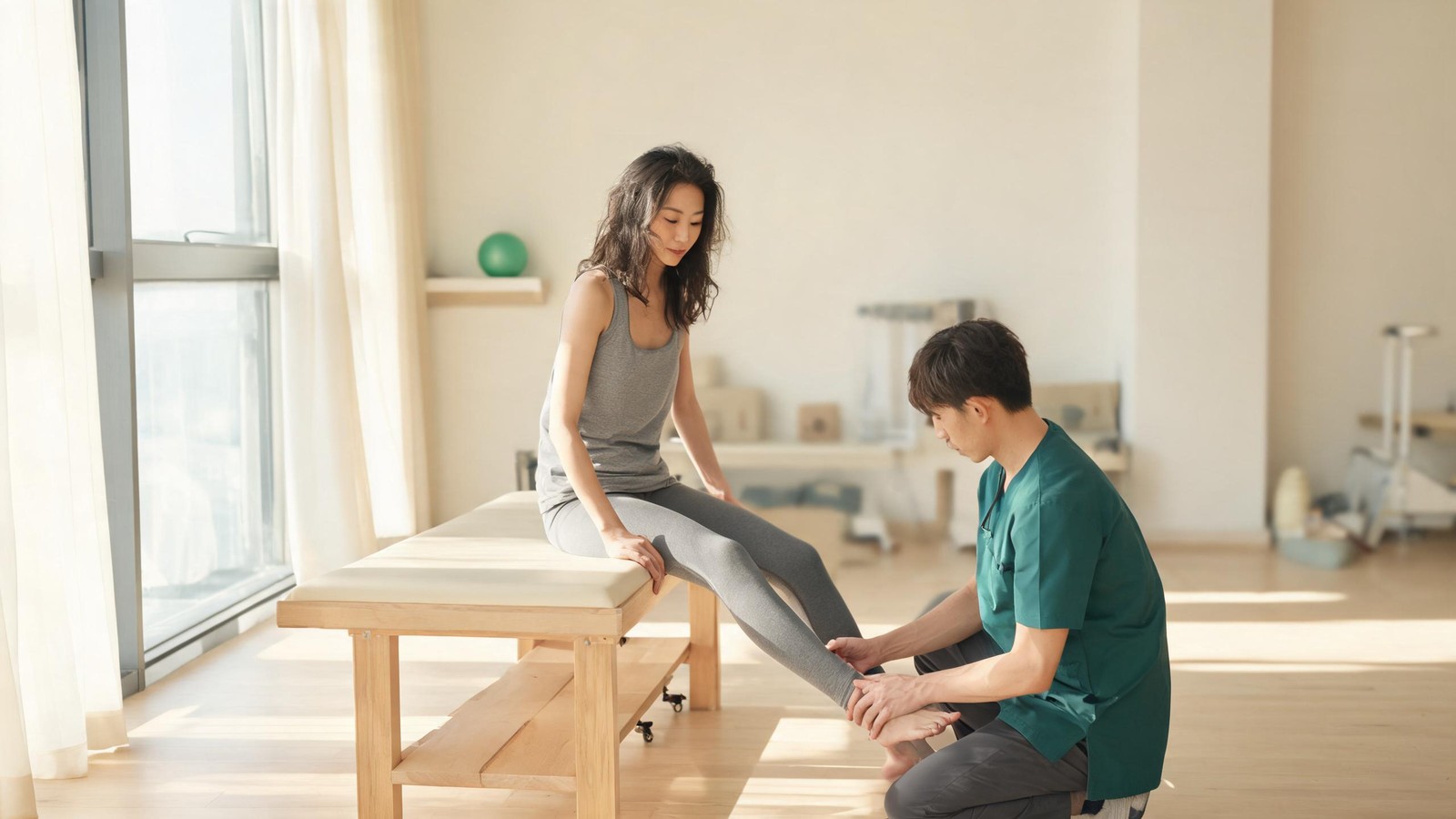
Shanghai's English-speaking physiotherapy clinics cluster in Jing'an, Changning and Pudong, and none of them publish their prices, so here is exactly what to ask before you book.
Shanghai has a solid cluster of English-speaking physiotherapy clinics, concentrated in Jing'an, Changning and Pudong. UP Clinic runs four branches, the clinic by International Rehabilitation Specialists sits on Jiashan Lu in Xuhui, and United Family, Parkway, Jiahui and Raffles all run rehab departments. None of them publish their session rates, so you have to call and ask, and the questions below are the ones that matter.
I put this guide off for a while because I wanted to open with a price table, the way we usually do. I could not build one honestly. Not a single clinic in this category publishes a session rate, and the numbers floating around forums and AI-generated health pages do not hold up when you check them. So this guide does something more useful instead: it tells you exactly who exists, where, and what to ask them on the phone so you find out the price before you are lying on the table.
Good to know
- Good for anyone with a sports injury, post-surgery rehab, or desk-bound neck and back pain who wants a physio they can actually talk to in English.
- What you'll pay no clinic in this category publishes a session rate, so you have to call and ask; private clinics sit well above a public-hospital registration fee, and the special-needs outpatient clinic at a public hospital is the cheaper middle path most people miss.
- Watch out for the insurance trap: many policies need a doctor's referral or pre-approval before physiotherapy is covered, so call your insurer before the first session, not after.
Is this physiotherapy, or is it a massage?
Worth settling first, because Shanghai bundles four different things under headings that look similar in English: evidence-based physiotherapy, chiropractic, tuina, and sports massage. They are not interchangeable, and the person treating you may hold a very different qualification depending on which door you walked through.
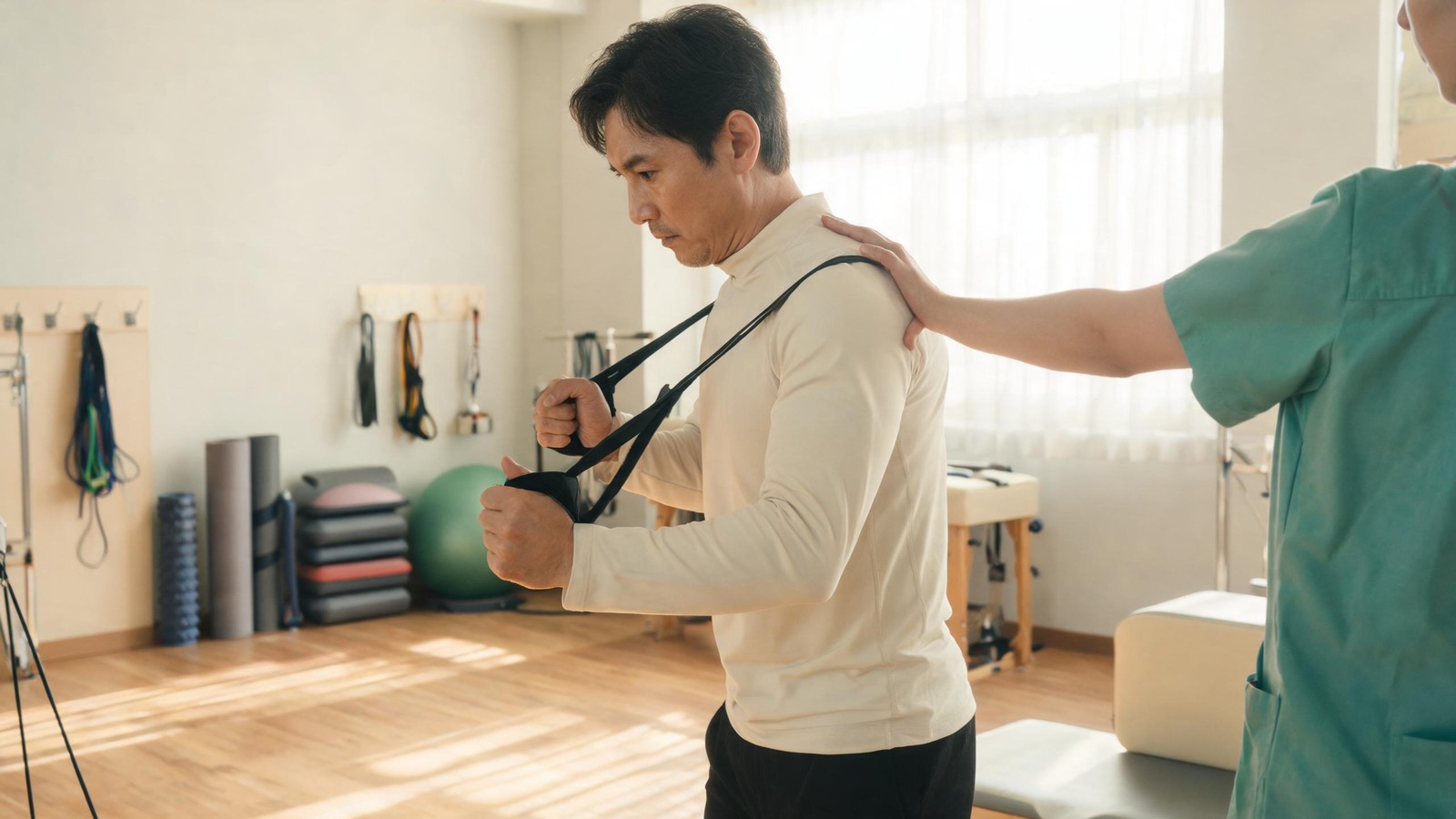
If you want physiotherapy in the sense you would recognise from home, look for a practitioner with a Doctor of Physical Therapy qualification or overseas physiotherapy training, and ask directly what the treatment plan looks like beyond the first session. A physiotherapy course of care should involve you doing exercises between appointments. If nobody gives you homework, you are probably in a passive-treatment room, which can feel good and does something different from rehabilitation.
Tuina and acupuncture have their own place, and plenty of people here run both alongside each other. We covered that side separately in our guide to traditional Chinese medicine in Shanghai.
Where are the English-speaking physiotherapy clinics in Shanghai?
UP Clinic, four branches
The widest coverage of any dedicated musculoskeletal clinic in the city, and the one most likely to have a branch near you. It works across orthopaedics, physiotherapy, chiropractic and sports medicine, and positions itself around conservative, non-surgical care.
- Jing'an: No. 432, 436 Dagu Road, near Shimen Yi Lu. Tel +86 21 6339 2668
- Huangpu: 56F, No. 300 Middle Huaihai Road, K11 Art Mall. Tel +86 21 6333 2788
- Changning: Room 301A, No. 1078 Gubei Road. Tel +86 21 6260 0668
- Pudong: Room 401A, Qiantan L+PLAZA, No. 345 Dongyu Road. Tel +86 21 5889 9889
the clinic by International Rehabilitation Specialists, Xuhui
Suite A501, 5/F, Building B, 118 Jiashan Road, near Yongkang Lu. Tel +86 21 3368 8801. Sports medicine, physiotherapy, post-surgical rehabilitation and sports performance work, with acupuncture and movement classes alongside. Worth a call if your issue is athletic rather than desk-related.
Physical Therapy Shanghai, Jing'an
Run by an APTA board-certified Doctor of Physical Therapy who trained at UCSF, a native English speaker who is also fluent in Mandarin, with a background in sports medicine and post-operative rehabilitation. The practice is near Jing'an Temple station on lines 2 and 7. It handles enquiries through WeChat and email rather than a published phone line, so start at physicaltherapy.cn.
The international hospital groups
All four run rehabilitation departments, and they are the sensible choice if you want physiotherapy joined up with imaging, orthopaedics and a GP under one roof.
- United Family runs physical medicine and rehabilitation at five sites including Changning, Pudong and Jing'an. Central appointments on 400 639 3900.
- Parkway lists physiotherapy at two clinics specifically: Biyun, at 997 Biyun Road in Jinqiao, Pudong, and Gubei, at 2F, No. 776 Huangjincheng Avenue in Changning. Central line 400-819-6622. Its physiotherapists are overseas-trained.
- Jiahui Health runs an orthopaedics and sports medicine centre at Jiahui International Hospital, No. 689 Guiping Road in Xuhui, with a clinic at 88 Changshu Road in Jing'an. Central line 400-8683-000.
- Raffles Medical runs physiotherapy and rehabilitation covering sports injury, musculoskeletal and post-surgical work, plus podiatry with gait analysis. 24-hour line +86 21 6197 2300.
Coverage is lopsided, and it is worth saying so plainly. Jing'an, Changning and Pudong are well served. Hongkou, Yangpu and most of Minhang are not, at least not in English. Factor the commute in, because a rehabilitation plan means turning up once or twice a week for six weeks, and a clinic across the city quietly becomes a clinic you stop attending.
What will it cost, and why can I not find a price?
Because nobody publishes one. I checked every clinic above and none list session rates online, and Parkway confirms it keeps its insurer arrangements at the billing desk rather than on its website. Any number you find in a forum thread is someone's memory of a different treatment at a different time, and several of the price lists circulating online are machine-generated rather than sourced.
What is safe to say is the shape of it. An international-style private clinic consultation in Shanghai costs an order of magnitude more than a registration fee at a public hospital, and physiotherapy sits at the private end of the market. There is also a middle path most people arriving here have never heard of: the special-needs or VIP outpatient clinics that major public hospitals run, which cost considerably more than a standard public registration and considerably less than an international clinic, with shorter queues and a better chance of an English-speaking specialist.
The five questions to ask when you call
- What does the initial assessment cost, and is it priced differently from follow-up sessions?
- How long is a session, and does that include hands-on time or just the room?
- Do you direct-bill my insurer, or do I pay and claim back?
- Does my policy need a doctor's referral or pre-approval before physiotherapy is covered?
- How many sessions would you expect for something like this, so I can budget the course rather than the visit?
Question four is the one that costs people real money, so it gets its own section.

Will my insurance cover physiotherapy?
Sometimes, and the conditions are where people get caught. Three things to check before you book.
Outpatient cover. Physiotherapy is an outpatient benefit. A policy that only covers inpatient treatment will not pay for it, and a lot of employer-provided plans are exactly that.
Referral and pre-approval. United Family states outright that some insurers require pre-approval or a medical referral before physical therapy. This is the trap: private clinics will happily take a direct booking, so you can walk in, get treated, and only then discover the claim needed a doctor's referral you never got. Call your insurer before the first appointment, not after.
Direct billing. Common at the international clinics and private hospitals, uncommon at public hospitals where you generally pay upfront and claim back. No provider publishes its insurer list, so you have to ask about your specific policy by name.
If you have not sorted cover yet, our guide to health insurance for expats in Shanghai goes through how the outpatient tiers actually differ.
What if I need surgery, not physiotherapy?
Worth knowing before you book a flight home. Shanghai Sixth People's Hospital runs a department of sports medicine that is a National Clinical Key Specialty, performing on the order of 15,000 procedures a year, a large share of all sports medicine surgery carried out in the city. For ligament, meniscus and rotator cuff work, that volume matters.
The trade-off is language and comfort rather than clinical capability, and it is a public hospital experience: queues, Mandarin, family members doing the logistics. A pattern that works well for a lot of people is surgery in the public system where the case volume is, then rehabilitation in English at a private clinic afterwards, which is also the phase where the language barrier does the most damage if you cannot follow the instructions.
Huashan Hospital, in Jing'an at 12 Wulumuqi Middle Road, runs an international medical centre with English-speaking staff and a rehabilitation department, and is open around the clock. If you are unsure how public hospital registration works at all, start with our step-by-step guide to seeing a doctor in Shanghai.
Which one is for you
If you have desk-related neck or lower back pain and want the shortest path to someone who speaks your language, choose whichever UP Clinic or international hospital branch is closest to your commute; proximity will matter more than the brand once week three arrives.
If you have a specific athletic injury or you are rehabilitating after surgery, choose a dedicated sports-focused practice such as the clinic on Jiashan Lu or Physical Therapy Shanghai, where the caseload matches your problem.
If cost is the binding constraint, ask your GP about the special-needs outpatient clinic at a major public hospital rather than defaulting to an international clinic, and expect to manage more of the process in Mandarin.
If you may need surgery, get the diagnosis and the operation where the case volume is, then do the rehabilitation in English.
Sources · 资料来源
- Standing Committee of the National People's Congress · 全国人民代表大会常务委员会, Insurance Law of the People's Republic of China · 中华人民共和国保险法 (Article 16, the duty of truthful disclosure), the statute that lets an insurer refuse a claim or cancel a policy when a material fact was not disclosed. npc.gov.cn
- National Financial Regulatory Administration · 国家金融监督管理总局 (successor to the former 银保监会), Health Insurance Administrative Measures · 健康保险管理办法 (Order No. 3 of 2019), which defines what commercial medical and rehabilitation cover pays and the licensed medical institutions it applies to. gov.cn
- Shanghai Medical Insurance Bureau · 上海市医疗保障局, rules on basic medical insurance rehabilitation items and payment at designated medical institutions · 定点医疗机构. ybj.sh.gov.cn
- This is general guidance drawn from official sources, not legal, insurance, or medical advice. Covered items and policy terms change, so confirm the current rules with your insurer and the relevant authority before you rely on a claim being paid.
As the Classic of Filial Piety puts it, 身体发肤,受之父母, your body, to the last hair, is a gift from your parents. A gift like that is worth the small trouble of reading the fine print before the day you need it.
Do I need a referral to see a physiotherapist in Shanghai?
Private clinics generally accept direct bookings without one, but your insurer may still require a referral or pre-approval for the claim to be paid. Check the policy before the first session rather than assuming the clinic's booking policy and your insurer's rules are the same thing.
How much cheaper is a public hospital than an international clinic?
Substantially, on the order of a small registration fee against a private consultation many times that. The gap narrows if you use a public hospital's special-needs outpatient clinic, which is the middle option most newcomers do not know exists.
Will the physiotherapist speak English?
At the clinics listed above, yes, though fluency varies between the practitioner treating you and the reception staff booking you. Ask when you call whether the specific therapist you are booked with speaks English, not whether the clinic does.
How many sessions will I need?
It depends entirely on the injury, and any clinic that answers this confidently before assessing you is selling rather than diagnosing. Ask for an expected range at the end of the first assessment so you can plan the cost across a course of treatment.
Can I claim physiotherapy on Shanghai's public insurance scheme?
Employees enrolled in the local social insurance scheme have access to treatment within the public system on the terms of that scheme, which does not extend to private international clinics. Most foreign residents using private physiotherapy are claiming through a commercial international policy instead.