Short version: no, you do not tip in Shanghai. Not the taxi, not the waiter, not the barista, not your Didi.
Short version: no, you do not tip in Shanghai. Not the taxi, not the waiter, not the barista, not your Didi. Nobody is standing there waiting for it, and leaving cash on the table reads as confusing more often than generous. The etiquette that actually decides whether you come across as gracious or clueless has almost nothing to do with money, and everything to do with a handful of small moves nobody writes down. Here they are, plainly, with the why, so you can be the guest people quietly want to invite back.
Good to know
- Good for newcomers who are secretly worried they are offending hosts and can't tell how; anyone about to eat with a Chinese family, colleague, or in-laws for the first time.
- What you'll pay nothing in tips almost everywhere; the only regular exception is a printed service charge (服务费, fúwùfèi) of about 10 to 15 percent at some upscale restaurants and hotels, already on the bill (the real ¥ numbers are in our Shanghai cost-of-living guide).
- Make the most of it learn three moves this week: let the host win the bill fight, pour tea for others before yourself, and take your shoes off at the door. That is 90 percent of looking gracious.
Do you tip in Shanghai, and are there any exceptions?
No, and yes but tiny. Tipping was never part of the culture here, and mobile payment finished the job: you scan a QR code, the exact amount leaves your wallet, done. There is no line to add a tip and no social pressure to. Rounding up a taxi fare by a few kuai because you don't want coins back is fine, but it is convenience, not custom.
The honest exceptions are narrow. A private tour guide or driver who gave you a full, personal day genuinely appreciates a little something. A five-star hotel bellhop won't refuse ¥10 to ¥20 (~USD 1.61 to 3). A spa therapist after a long massage may get a small goodwill note. None of these are expected, and skipping all of them marks you as nothing at all. Here is the whole map, as of 2026.
| Situation | Tip | Reality |
|---|---|---|
| Restaurant, cafe, bar | ¥0 | Upscale spots may add 10 to 15% service charge; it is on the bill |
| Taxi or Didi | ¥0 | Round up if you like; nobody expects it |
| Food and coffee delivery | ¥0 | Fee is baked into the app price |
| Hotel bellhop (5-star) | ¥10 to 20 | Optional, welcomed at international hotels |
| Spa or massage therapist | ¥20 to 50 | Goodwill, not expected |
| Private tour guide or driver (full day) | ¥100 to 200 | The one place a real tip lands as gracious |
In US dollars, roughly a bellhop tip is $1.61 to $3, a spa tip $3 to $8, and a full-day guide $15 to $30. Converted at about 6.7 RMB to the dollar, August 2026, so treat the dollars as a ballpark.
If you are still learning to read menus and prices, our guide to using Dianping in English will show you what a place actually charges before you sit down, service fee included.
Who pays the bill, and why fighting for it is polite
Whoever invited you pays. Full stop. In Chinese dining, the host (请客, qǐngkè) covers the table, and offering to split can feel like you are rejecting their hospitality. This is why you will see two people almost wrestle over the check, each shoving a phone at the QR code. It looks dramatic. It is theater, and it is warm: the fight to pay is the way people show they value you.
What you do as the guest: offer once, sincerely, then let them win with a genuine thank-you and a promise to get the next one. Among younger friends and colleagues, splitting the bill (AA制) is completely normal, so read the room. But if an older person, a boss, or a host invited you, do not out-fight them for the check. Let them have the face, and reciprocate another day.
The table moves: the lazy susan, pouring tea, and the two-finger thank-you

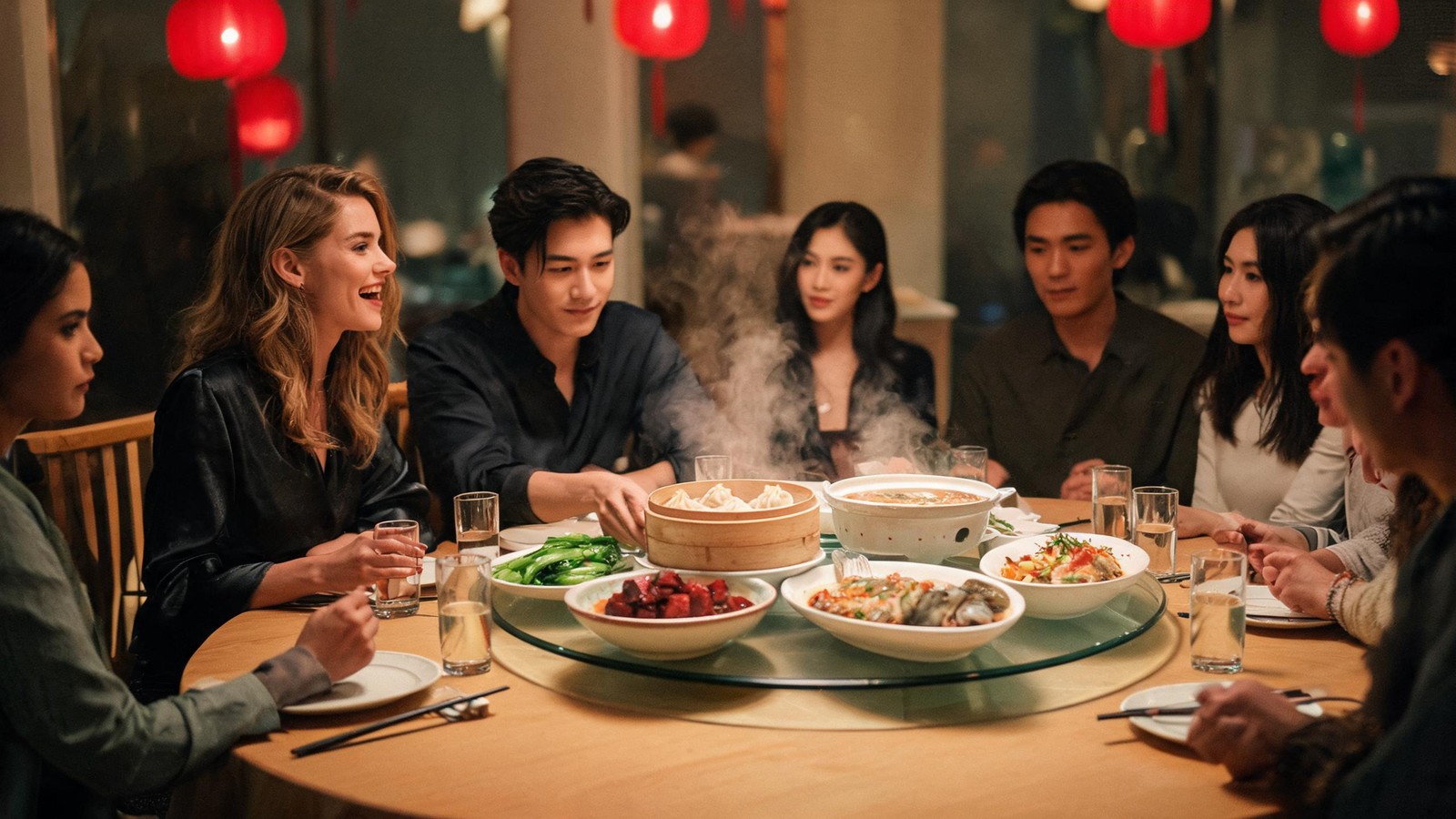
Round tables have a spinning glass wheel in the middle. Turn it slowly and clockwise, and never spin it while someone is mid-serve or reaching in with their chopsticks. Let the eldest or the guest of honor take from a new dish first; it costs you nothing and it is noticed instantly.
Tea is where you can shine. When you pour, fill everyone else's cup before your own, starting with the oldest person at the table. And when someone pours for you, do the local thank-you: tap two bent fingers on the table twice (叩手礼, kòu shǒu lǐ). It is a silent bow with your hand, and it makes you look like you have been here for years.
Three quick don'ts that carry real weight: never stand your chopsticks upright in a bowl of rice (it mimics incense for the dead), don't tap your bowl with them (a beggar's gesture), and when you toast (干杯, gānbēi) with someone senior, clink your glass slightly lower than theirs. Lower rim, more respect.
Gifts that quietly offend: clocks, white flowers, and the red envelope

Chinese gift taboos run on puns, and a few are landmines. The big one: never give a clock. "To give a clock" (送钟, sòng zhōng) sounds exactly like "to see someone off at the end of life" (送终). It reads as wishing death. Also skip these: white or yellow chrysanthemums and white flowers in general (funeral flowers), anything in a set of four (四, sì, sounds like 死, sǐ, death), pears to share (分梨, fēn lí, sounds like "separate"), umbrellas (伞, sǎn, sounds like "to part"), sharp knives or scissors (cutting the bond), and a green hat for a man, which carries its own unfortunate meaning about his wife.
Safe and loved: good tea, nice fruit in an even count, imported chocolate or wine, quality snacks, anything red and gold. Hand a gift over with both hands, and don't be surprised if the receiver sets it aside unopened rather than tearing in front of you. That is politeness, not disinterest.
The red envelope (红包, hóngbāo) is cash, given at weddings, New Year, and to kids. The rules: crisp new bills, even numbers, and never an amount with a four in it. Numbers with 6 (smooth) and 8 (prosperity, 发) are lucky, which is why you see amounts like ¥200 (~USD 30), ¥666 (~USD 100), or ¥888 (~USD 132). A digital WeChat red packet caps at ¥200 (~USD 30) per envelope, as of 2026, so bigger gifts go as a plain transfer or physical cash.
What "face" (给面子) really means, and how not to take it away
Face (面子, miànzi) is someone's public dignity, and almost everything above is really about it. Giving face (给面子) means making the other person look good in front of others; making them lose face (丢面子) means embarrassing them publicly, even accidentally.
In practice: don't correct or contradict someone sharply in front of a group, don't turn down an invitation with a flat "no" (soften it, offer a reason, suggest another time), and do praise people warmly where others can hear. If you have a criticism, deliver it privately and gently. This is the same warmth that makes the rest of Shanghai open up to you; if you are working on that, our honest read on where expats actually meet people here pairs well with this.
Shoes off, queues, and elevators: the small daily tells
Walk into a Chinese home and take your shoes off at the door. Most hosts have guest slippers (拖鞋, tuōxié) waiting; slip them on. Doing this unprompted is one of the fastest ways to signal you get it.
A few more that quietly mark you: in a lift, whoever is nearest the buttons plays operator and asks others which floor; hold the door and let people exit before you enter, on both elevators and the metro. Queues in Shanghai have gotten genuinely orderly, especially for the metro and popular restaurants, so join the back of the line rather than drifting to the front. And one small, strange one worth knowing: never write a person's name in red ink. Historically red ink on a name signals death, and it unsettles people even now.
None of this requires you to become someone else. It is the same instinct you already have as a good guest anywhere, just pointed at the local grain. Get the shoes, the bill, and the tea right, and you will feel the room warm toward you.
Confucius offered a whole etiquette in one line, 己所不欲,勿施于人, do not do to others what you would not want done to you. Where tipping is not the custom, courtesy is simpler than you fear, just the ordinary respect you would hope to receive.
Is it rude to tip in China?
Not rude, just unusual and sometimes confusing. Staff are not tipped and may try to return the money or chase you down to give it back. In everyday restaurants, taxis, and cafes, simply don't. Save any tipping for a private guide or a hotel bellhop, where it lands as a genuine thank-you.
Do you tip taxi drivers or Didi in Shanghai?
No. Fares are metered or set in the app and paid by QR code, so there is no tipping step. Rounding up by a few kuai to avoid coins is fine but entirely optional, and drivers do not expect it.
How much do you put in a red envelope in Shanghai?
It depends on the occasion and how close you are, but the rules matter more than the number: use even amounts, favor 6 and 8, and never include a 4. Casual gifts land around ¥200 (~USD 30); wedding envelopes from good friends often run several hundred to a couple thousand yuan. Digital WeChat red packets cap at ¥200 (~USD 30) each as of 2026.
Do you take your shoes off in Chinese homes?
Yes, almost always. Take them off at the entrance and use the guest slippers your host provides. If you are unsure, glance at the door for a shoe rack or a pile of shoes, which is your cue.
What gifts are unlucky in China?
Several, and they nearly all turn on unlucky puns. The ones people genuinely flinch at are clocks (they sound like seeing someone off at death), anything in fours, and white funeral flowers. When in doubt, give something consumable and even-numbered: good tea, a pair of nice fruit, wine, chocolate, anything red and gold.