
You do not need to read Chinese to use Xiaohongshu in English. You need twelve Chinese words, the translate button, and a healthy pause before believing a flawless review.
You do not need to read Chinese to use Xiaohongshu in English. You need twelve Chinese words, the translate button, and a healthy pause before believing a flawless review. RedNote is the international name for the same service, not a separate account you need to open again.
The feed is designed to keep you looking. Search is what makes the app useful. That distinction matters in Shanghai, where a two character word can be the difference between ten polished venue launches and one person telling you the restaurant has a thirty minute queue and no card machine.
Set up Xiaohongshu in English, then leave the feed
Download the official listing from your app store. Outside China it may appear as RedNote; in China look for 小红书. Current research describes the same application with shared accounts and public content, so there is no need to open a second account just because the store name changed. Login choices and English labels vary by region and version.
After login, open your profile and look for language or translation settings. Newer international versions can translate captions and comments. Text baked into a photograph may still need your phone's screenshot translation. Keep the Chinese venue name on screen. That is the one piece you can paste into a map or show a driver.
- Install the official app. Search 小红书 or RedNote and avoid unofficial download sites.
- Use the login method offered in your region. Phone, Apple and WeChat choices can differ by device.
- Enable translation. Look for 翻译 near a caption or in language settings.
- Tap search rather than Explore. The magnifier is where the practical Shanghai notes begin.

Twelve Chinese searches that unlock local Shanghai
Use this formula: place or subject + one intent word. Start broad, then add a district, a price or the kind of day you are planning. This is the table to screenshot.
| Search term | What it finds | Useful example |
|---|---|---|
| 推荐 · tuī jiàn | Recommendations | 静安 咖啡 推荐 |
| 攻略 · gōng lüè | Practical guides and routes | 上海博物馆 攻略 |
| 实测 · shí cè | Tested in real life | 徐汇 理发 实测 |
| 避雷 · bì léi | Warnings and disappointments | 店名 + 避雷 |
| 翻车 · fān chē | When something went wrong | 店名 + 翻车 |
| 人均 · rén jūn | Average spend per person | 静安 火锅 人均 |
| 平替 · píng tì | Lower priced alternatives | 品牌名 + 平替 |
| 免预约 · miǎn yù yuē | No reservation needed | 景点名 + 免预约 |
| 排队 · pái duì | Queue reports | 店名 + 周五 排队 |
| 一人食 · yī rén shí | Eating alone | 徐汇 一人食 |
| 带娃 · dài wá | With children | 上海 带娃 周末 |
| 真实体验 · zhēn shí tǐ yàn | Personal accounts, still verify them | 项目名 + 真实体验 |
Before an expensive decision, search three ways: praise, warning and real price. Try 徐汇 理发 推荐, then 徐汇 理发 避雷, then 徐汇 理发 人均. The point is not to become suspicious of everyone. It is to give the disappointed customer one chance to speak before the launch photos make the decision for you.
The 30 second check behind a glowing Xiaohongshu note

A polished note can be a genuinely lovely visit. It can also be a campaign. The responsible answer is not to declare every beautiful photograph an ad. Look for corroboration: ordinary details, a history of varied posts, and independent notes that describe the same experience without sharing the same script.
| What you notice | What it may mean | Your next move |
|---|---|---|
| The same distinctive phrase across accounts | A shared brief, or simply a trend | Search the phrase and sort by newer notes |
| Perfect launch photos, no bill or queue | A styled shoot rather than a full visit | Look for 实测 and recent customer photos |
| Only polished product posts on the account | Promotional content rather than a rounded life | Find two unrelated accounts before deciding |
| Specific prices, wait times and drawbacks | A visit with details you can check | Confirm the date and current conditions |
A recommendation that survives the warning search is worth more than ten that only survived a photo shoot.
Get the exact Xiaohongshu venue into your map
Many venue notes carry a location tag under the photographs. Open it to confirm that the notes refer to the same branch. Copy the Chinese venue name, then paste it into Amap, 高德地图, or your preferred map. The exact characters remove most of the guesswork, especially when a brand has five branches with similar English names.
If there is no location tag, look in the caption and comments for the branch name. Do not navigate from a translated nickname alone. And if a note is months old, check a newer post or the venue's current listing before crossing the city. The internet is full of excellent directions to places that have since moved.

For the other half of local research, our Dianping English guide covers menus, ratings and booking. Xiaohongshu is often more useful for the lived story. Dianping is often more useful for the structured details.
When Xiaohongshu is the wrong place to look
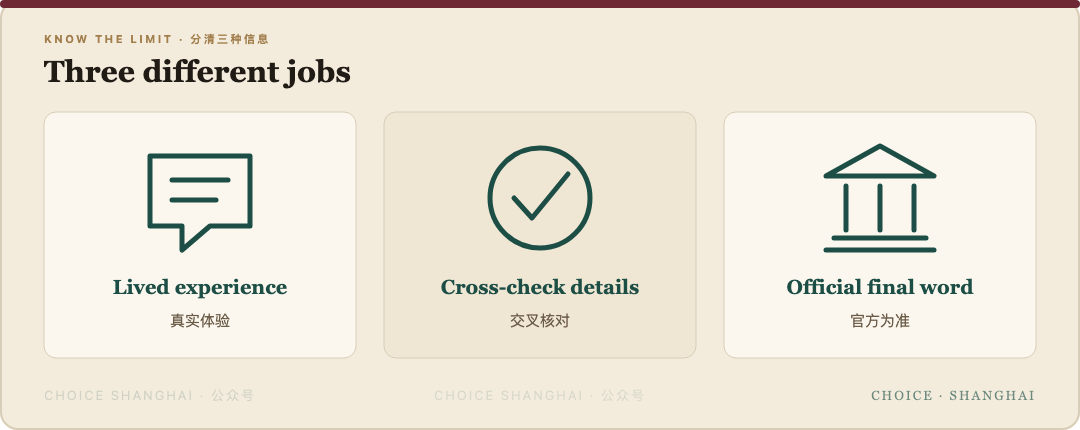
Do not use a lifestyle app as the final word on a visa, a medical decision, a legal dispute or a tax bill. A personal account can show you what a process felt like, but it cannot prove the rule still applies to you. Use the story to learn which office, form or question to ask, then verify with the issuing authority.
- Good use: “What was it actually like?” Queues, atmosphere, portions and whether a place works with a stroller.
- Cross check: “How much and when?” Prices, opening hours and appointment rules change.
- Wrong final source: “Is this legal or medically right for me?” Use the relevant authority or a qualified professional.
For a broader phone setup, our guide to the Shanghai apps you actually need puts search, payment, maps and transport in one place.
Good to know
- Good for: finding local restaurants, salons, clinics, day trips and real-life logistics through Chinese search.
- The formula: place or subject + 推荐, 攻略 or 实测. Then check 避雷 and 人均 before spending.
- The trust habit: inspect the account, look for ordinary details, and find two independent notes.
- The navigation habit: copy the exact Chinese branch name into 高德地图.
- The limit: personal notes are for lived experience, not the final source for law, health or eligibility.
Why can I read the caption but not the writing in a photo?
Caption translation does not necessarily translate text baked into an image or video. Use your phone's screenshot or live-text translation for that layer, and keep names in Chinese for searching.
What is the difference between 赞 and 收藏?
赞 is a like. 收藏 saves the note so you can find it again. For a route, a checklist or a restaurant you genuinely intend to visit, save it rather than relying on your liked history.
Can I use Xiaohongshu on a computer?
You can view many public notes through xiaohongshu.com, but the mobile app usually gives you the fuller search, translation and account experience. Browser features can differ by login and region.
How do I make the recommendations less repetitive?
Search deliberately and save only what you want more of. The recommendation system learns from activity, so twenty impulsive likes can reshape your feed faster than you expect.
Sources · 资料来源
- Bellingcat, Mining China's Little Red Book for Open Source Gold, April 2026. Used for the shared RedNote and Xiaohongshu service, translation behaviour and search interface.
- Xiaohongshu, 小红书 official site. App features, login options and menu labels can change by version, device and region.
- Checked 4 November 2026. This guide explains research habits, not a guarantee that any user recommendation is accurate or current.
As the Zizhi Tongjian puts it, 兼听则明,偏信则暗: listen to more than one side and the picture becomes clearer. It is a very old rule that happens to work beautifully on a very new app.
Words, fashion editorial imagery and research by Choice Shanghai. Please credit us and tag our 公众号 if you share.